










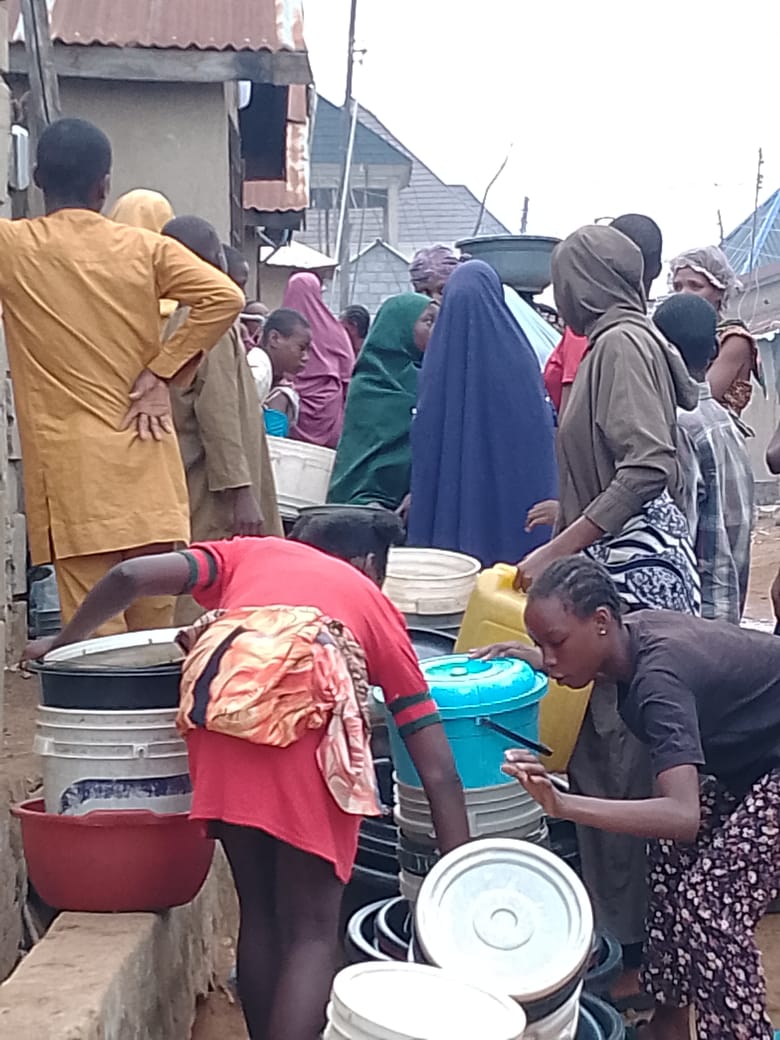
For nearly a month, residents of Idu Koro, the host community of the Idu Industrial Area in the Federal Capital Territory (FCT) and environs have lived without running taps, forced to gamble with their health for every drop. Our anchorman, Ekuson Nw’Ogbunka, examines how this prolonged scarcity threatens lives and why urgent intervention from FCT Minister Barr. Nyesom Wike and AMAC Chairman Hon. Christopher Zakka is now a matter of survival.
Water, they say, is life. A popular Igbo adage puts it plainly: “Water is the life of the fish.” But the water in question is not just any liquid. It must be clean, treated, and safe to sustain human life.
For about a month now, residents of Idu Koro, the ancient host community of Idu Industrial Area in the Federal Capital Territory, and surrounding settlements, have endured a total cut-off of pipe-borne water.
The scarcity has turned daily routines into survival exercises. Families now rely on “anything in the name of water” for cooking, drinking, bathing, washing clothes, and other domestic needs.
With public taps dry, many households have resorted to untreated boreholes scattered across the area. The quality of these boreholes is questionable, and most lack proper treatment or regular testing.
Others trek long distances to fetch water from streams whose sources are unknown and exposed to contamination. The water is often murky, with visible debris and a foul smell.
In desperate cases, residents admit to secretly drawing water from gutters and drainage channels. The risk is enormous, but thirst and necessity leave little room for choice.
Health experts warn that water-borne diseases do not negotiate. Cholera, typhoid, dysentery, and diarrhea can kill massively when clean water is unavailable, especially among children and the elderly.
If the current situation is not curtailed, the result could be disastrous. A single outbreak in a densely populated area like Idu could overwhelm nearby clinics and health centers.
Idu Koro bears the burden of hosting the Idu Industrial Area, yet its basic amenities lag far behind the development around it. The irony is not lost on residents who see pipelines and infrastructure serving factories while their homes go dry.
That is why the attention of FCT Minister, Barr. Nyesom Wike, is being drawn to this crisis. He is widely known for delivering infrastructure and amenities that make life worth living across the nation’s capital.
The AMAC Chairman, Hon. Christopher Zakka, is also expected to join the rescue effort. As the local government closest to the people, AMAC has a critical role in bridging the gap while permanent solutions are pursued.
Residents are not asking for complex engineering overnight. What Idu and environs need urgently is a well-drilled, properly treated borehole with maintenance, especially during periods of pipe-borne water scarcity like this.
A functional borehole would provide immediate relief, reduce dependence on unsafe sources, and buy time for the FCT Water Board to restore consistent supply to the area.
If what is said about the Minister’s performance in the FCT is anything to go by, then his intervention here will fit the pattern of responsive governance he has been known for.
The time to act is now, before things get out of hand. For the people of Idu Koro, water is not a luxury or a political promise. It is life. And life cannot wait.