








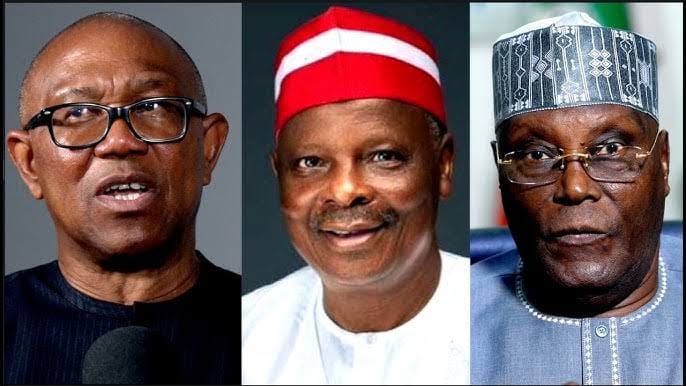
With the G-100 opposition unity summit now shifted to August 31, 2026 in Ibadan/Abuja, the race to produce a single candidate against the APC is entering its most critical phase. While Atiku Abubakar, Peter Obi, and Rabiu Kwankwaso remain the names most discussed, a growing argument within political circles is that Obi presents the strongest path to victory, if ego gives way to strategy. Here is a news analysis of the frontrunners, the hurdles, and what the August 31 meeting must decide for Nigeria’s opposition, writes Ekuson Nw’Ogbunka.
The G-100 consultations with six parties, ADC, APM, NDC, PDP, PRP, SDP, have narrowed the conversation to three men.
The former Vice President brings structure, funding, and deep experience. He has contested six times and retains strong base in the North-East and among PDP/ADC governors. His role in 2019 coalition talks also gives him institutional memory. However, he carries two major liabilities: the “perennial candidate” tag and age. He will be 80 in 2027, a point the APC is already preparing to exploit.
Peter’s Obi’s strength is not structure, but momentum. The 2023 “Obedient” movement proved he can mobilize youth, urban voters, and first-time voters without big money. His message on cutting government waste directly taps into 2025/2026 voter anger over cost of living. His weakness is clear: limited governors and party machinery, and the need to overcome the “South-East only” perception. Yet analysts argue his baggage is the easiest to fix through alliances.
Rabiu Kwankwaso delivered Kano in 2023 and commands a loyal North-West following. As a 2-term governor and former Minister, he is not tied to PDP’s old guard. But his reach is largely regional. Without a strong Southern partner, a Kwankwaso-led ticket struggles for national spread. Trust issues from past failed coalition talks also remain.
Oyo Governor Seyi Makinde is being positioned as a bridge and potential VP/consensus builder. Civil society voices have also mentioned technocrats like Donald Duke and Oby Ezekwesili, though they remain long shots unless there is a total reset.
The argument for Obi rests on four points, of voter energy. In a likely low-turnout 2027 election, the Obidient base that donates and campaigns for free could be decisive. Another point, is that anti-APC sentiment, meaning that, Obi owns the “cut waste” and economic discipline message, while Atiku and Kwankwaso are more easily tied to the old system.
The other is regional balance. Though South-East, Obi pulled significant votes in Lagos, Abuja, Port Harcourt and Benin in 2023. Paired with a strong Northern VP from Kwankwaso’s camp or a credible North-East/NC governor, the ticket becomes nationally viable.
Added is baggage. Compared to Atiku’s age and history, and Kwankwaso’s regional limits, Obi’s need for structure is a more solvable problem.
Obi cannot win alone. The formula analysts keep repeating is: Obi as President and Atiku/Kwankwaso camp as VP, key ministries, governors. That is the “1+1=3” scenario. If the ticket is led by Atiku or Kwankwaso instead, there is a high risk Obi’s base sits out — handing APC the advantage by default.
The three hurdles before August 31 should be firstly, zoning. North vs South. Atiku and Kwankwaso are Northern. Obi is Southern; secondly, ego and sacrifice, G-100 itself admits this will require “significant sacrifice.” Who steps down?
Thirdly, is platform. Will they merge into ADC, create a new party, or adopt one existing platform?
The G-100 position is blunt, a fragmented opposition cannot beat APC. The pressure is therefore on the Big 3 to cut a deal. The APC has dismissed the effort as “an exercise in futility,” a statement analysts read as proof the ruling party sees the coalition as a real threat.
As of today, Atiku, Obi and Kwankwaso are the only viable contenders. But the emerging consensus is that, Obi as presidential candidate with a Northern VP offers the best combination of youth + structure + national spread. If ego blocks that arrangement, the “single candidate” project risks collapsing before 2027.
All eyes are now on August 31. The summit’s outcome, who endorses whom, who walks out, and what platform is adopted, will determine whether this is a genuine alternative or another round of opposition talks that fizzled.