
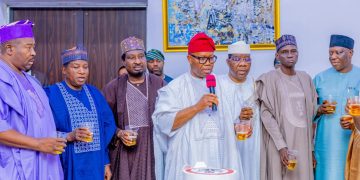



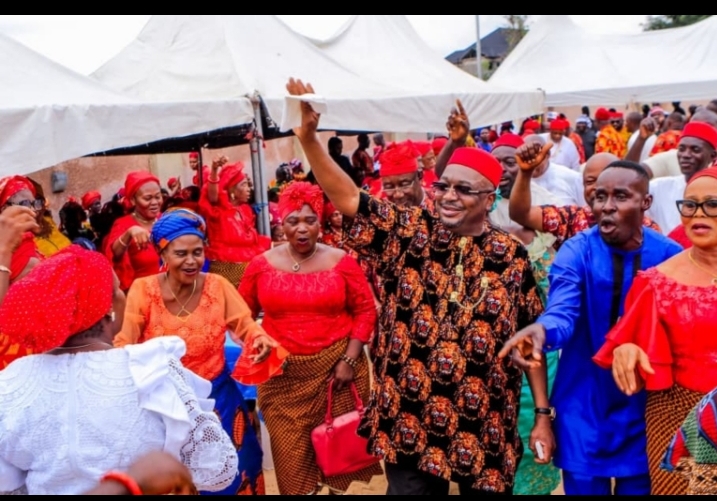
Senator Philip Tanimu Aduda, the All Progressives Congress (APC) senatorial candidate for the Federal Capital Territory (FCT), has called for a renewed relationship and stronger partnership between political leaders in Abuja and the Igbo community. Aduda made the call when he visited Ndigbo at the palace of Onyendu Ndigbo, Dr Uche Egenti, where he called for more understandings and collective effort to deliver the nation’s capital.
The former senator also expressed appreciation to the Igbo community for its support during the burial of a member of his extended family, as well as for its contributions to the development of the FCT. He commended the FCT administration for infrastructure projects and initiatives which, according to him, have benefited residents and businesses, including members of the Igbo community.
Distinguished Philip Aduda speaks on his relationship with Ndigbo, his appreciation of the community, the role of Igbo stakeholders in Abuja, the need for unity and his vision for a stronger partnership going forward, and Ekuson Nw’Ogbunka, Our Managing Editor was there. Just read the excerpts.
Senator Aduda, you have described yourself as being at home whenever you are with Ndigbo. What does your relationship with the Igbo community mean to you?
My relationship with Ndigbo goes beyond politics. It is a relationship that has existed for many years, through my parents, my family, the church and personal friendships. Many of the people here today were friends of my father and mother before they became my friends.
So, whenever I come here, I feel at home. I know many of you personally, and I know the roles you have played in the development of Abuja. That is why I am here today, not simply as a politician, but as a brother and friend.
You also spoke about your relationship with Chief Mao Abba and other prominent people. How important are such relationships to you?
They are very important. Distinguished Senator Mao Abba is like an uncle to me. My parents handed me over to him, and he has continued to guide me very well.
He is somebody who will call you whenever he feels you need to be corrected. Sometimes, when I see his call, I ask myself, “What have I done now?” But that is what family is about. He wants the best for me, and I appreciate him.
I also have a very good relationship with many of the leaders and elders here. These relationships are built on trust, respect and mutual understanding.
You acknowledged that there were mistakes in the past. What exactly do you mean by that?
What I mean is that there were times when we did not reach out sufficiently to one another. There were misunderstandings and areas where we could have done better.
I will be the first to admit that even I did not reach out as much as I should have, particularly to some people who are my brothers. But the important thing is that we have recognised those mistakes.
As I said here, we made mistakes in the past, but we are back on the same page and on the same table. The future should not be about dwelling on those mistakes. It should be about correcting them and moving forward together.
Why did you consider it important to visit Ndigbo at this particular time?
I came primarily to greet my people and to appreciate them. I also wanted to listen to them.
Politics should not be about appearing only when you need votes. There must be a relationship before politics and after politics. We need to sit together, discuss our challenges and determine how we can work together for the benefit of everyone living in Abuja. That is the essence of my visit.
You spoke extensively about the contributions of the Igbo community to Abuja. What is your assessment of their role in the FCT?
Ndigbo have contributed enormously to the economic development of Abuja. They are involved in businesses, transportation, trading, construction, mechanical services and many other areas.
Their contribution is visible across the Federal Capital Territory. When people talk about Abuja’s economic growth, they cannot ignore the role played by the Igbo community.
That is why anything that makes it easier for them to do legitimate business, obtain proper documentation and live peacefully should be encouraged.
You commended some infrastructure initiatives in the FCT. How do you think these projects affect the Igbo business community?
Infrastructure is very important to business. When roads are good, people can move goods and services more easily, and businesses become more productive.
For instance, some of the road improvements have significantly reduced travelling time in certain parts of the FCT. That is good for everybody, including our brothers and sisters from the South-East who operate businesses here.
When you improve infrastructure, you are not helping one ethnic group. You are helping the entire FCT.
You also mentioned initiatives concerning relocation and allocation of spaces for businesses. Why is this important?
It is important because businesses need certainty. People need to know where they are operating, have proper documentation and be able to conduct their businesses without unnecessary harassment.
The efforts to provide allocation letters, documentation and suitable locations for businesses are therefore important.
If we can resolve these issues properly and transparently, it will create a better environment for businesses to thrive and contribute more to the economy of Abuja.
You urged Ndigbo to support people from the South-East who are serving in the FCT administration. Why?
If one of your brothers comes from the South-East and is given an opportunity to serve the FCT, the right thing is to support him and encourage him to succeed.
But support must also come with constructive engagement. We must sit with our leaders, identify our challenges and explain what we need.
It should not be about confrontation. It should be about dialogue, understanding and finding solutions.
You spoke about the involvement of Igbo stakeholders in political appointments in the FCT. What point were you making?
My point is that many of these appointments did not happen without consultation. There were discussions, and people sat down together to agree on who should occupy certain positions.
That shows that there is room for inclusion and participation. Today, some people even complain that Ndigbo have received substantial representation in certain areas.
Whether you look at the appointments or other opportunities, what matters is that people are included and given the opportunity to contribute.
How would you describe your personal relationship with some Igbo political appointees and associates?
I have had very good relationships with many of them for years.
Some of them worked directly with me before taking up their current responsibilities. For example, Lawrence has been my friend for many years and has worked with me on several projects. Arinze also worked closely with me and later became my Special Adviser.
These relationships did not start today because of politics. They existed long before the current political circumstances.
Does your relationship with Ndigbo extend beyond politics?
Absolutely. The relationship extends to the church, family and community life.
I am an Anglican, and through the Anglican Church, my parents and I have worked with many members of the Igbo community over the years.
Some people here are not simply political associates. They were friends of my parents. That kind of relationship is deeper than politics.
You thanked Ndigbo for their support during a recent burial in your family. How significant was that gesture?
It meant a lot to us. We lost a member of our family recently, and many members of the Igbo community came to support us during the burial.
I want to sincerely thank the chiefs, leaders and everyone who came or supported the family. That kind of gesture demonstrates what true community and friendship are about.
I pray that God Almighty will meet everyone at the point of their needs.
What message do you have for Igbo leaders and organisations in Abuja going forward?
My message is that we should continue to engage one another. Let us put our differences aside and concentrate on what unites us.
We should organise ourselves properly, speak with one voice where necessary and maintain constructive relationships with the government and other communities.
Nobody wins when there is unnecessary division. We all win when there is peace, understanding and cooperation.
As the APC senatorial candidate for the FCT, what should Ndigbo expect from you?
They should expect accessibility, dialogue and commitment.
I am not somebody who believes that politics should separate people. I want to work with everyone—Ndigbo, Hausa, Yoruba, Gbagyi and all the other communities that make up Abuja.
My commitment is to represent the interests of the people and ensure that their concerns are heard.
What is your message regarding the 2027 political process and the need for unity?
The 2027 process should be approached with maturity. We need to talk to one another, understand our interests and look at how we can move forward together.
I know that Ndigbo love me, and I also know that I love them. That is why I believe we can sit together, deliberate and find common ground.
Politics should not destroy relationships that took many years to build.
Finally, what would you like Ndigbo to remember about your visit and your message today?
I want them to remember that I came as a brother and friend.
I appreciate their support, their contributions to Abuja and the relationships we have built over the years. I also acknowledge that there were mistakes in the past, but we have an opportunity to correct them.
Let us return to the same table, talk to one another and work together. If we remain united and support one another, we can achieve much more.
I pray that God Almighty will crown our efforts with success and give us the wisdom to move forward together.