

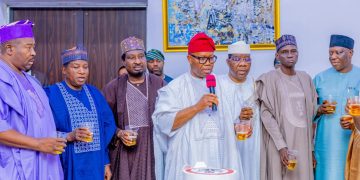








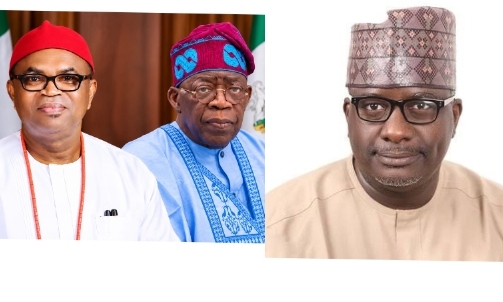
The 2027 presidential contest is gradually assuming a new dimension as political groups and support organisations intensify efforts to mobilise stakeholders across Nigeria’s geopolitical zones. Against this backdrop, the courtesy visit by Hon. Humphrey Nsofor, National Coordinator of the Southeast Elders and Youth Alliance for Tinubu 2027, to the Director-General of the Tinubu Support Group, Dr. Umar Tanko Yakasai, signals an attempt to deepen political engagement and build a broader support structure for President Bola Ahmed Tinubu ahead of the 2027 elections, writes Ekuson Nw’Ogbunka, Our Managing Editor in Abuja.
The meeting is significant because it brings together two layers of political mobilisation: the national structure represented by Yakasai and a Southeast-focused coalition led by Nsofor. Their engagement suggests that supporters of the President are increasingly looking beyond conventional party structures to build grassroots alliances capable of delivering votes across communities and interest groups.
For the Southeast, the political calculation is particularly important. The region has historically been a critical battleground in presidential politics, with voters often responding strongly to issues of inclusion, equity, federal appointments, infrastructure, economic opportunities and the relationship between the Federal Government and the region. Any serious attempt to expand Tinubu’s support in 2027 will therefore require sustained engagement with Southeast stakeholders rather than relying solely on party machinery.
Yakasai’s position as Director-General of the Tinubu Support Group also places him at an important point in the emerging campaign architecture. His interaction with Southeast political actors could provide a platform for supporters of the President to communicate the administration’s achievements, defend its policies and address areas where the government may still face criticism.
At the same time, the initiative reflects the reality that political support cannot be taken for granted. The 2027 election is expected to be highly competitive, with opposition forces and various political movements seeking to consolidate their own regional and national alliances. Consequently, groups campaigning for Tinubu will have to demonstrate why voters, particularly in areas where support for the President may not yet be overwhelming, should remain with the ruling party.
The Southeast Elders and Youth Alliance for Tinubu 2027 is also noteworthy because of its attempt to combine two influential constituencies, elders and young people. While traditional political leaders remain important in determining electoral direction, young voters constitute a major force in Nigeria’s electorate. A campaign strategy that successfully connects established political networks with younger Nigerians could potentially create a more sustainable mobilisation structure.
However, political alliances are ultimately tested at the polling booth. Courtesy visits, endorsements and support groups can generate momentum, but converting such enthusiasm into votes requires organisation, credible messaging, effective grassroots mobilisation and the ability to respond to voters’ economic and social concerns.
For Tinubu, the Southeast presents both an opportunity and a challenge. The opportunity lies in expanding his electoral coalition beyond his strongest traditional political bases. The challenge is convincing voters that his administration’s policies and programmes offer tangible benefits that justify another mandate
The emerging engagement therefore appears to be part of a larger battle for political space ahead of 2027. Rather than viewing the Southeast simply as an electoral bloc, the Tinubu support campaign will need to engage its diverse political, ethnic, religious, business, youth and community interests individually and strategically.
Ultimately, the significance of the Yakasai-Nsofor engagement may lie less in the courtesy visit itself and more in what follows. If it develops into sustained consultations, grassroots mobilisation and concrete political partnerships across the Southeast, it could become an important component of Tinubu’s wider 2027 re-election strategy.
As the race gathers momentum, the central question will not merely be who has the loudest support groups, but who can translate political alliances into a credible, broad-based electoral coalition.
For Tinubu’s supporters in the Southeast, the work of building that coalition appears to have already begun.