










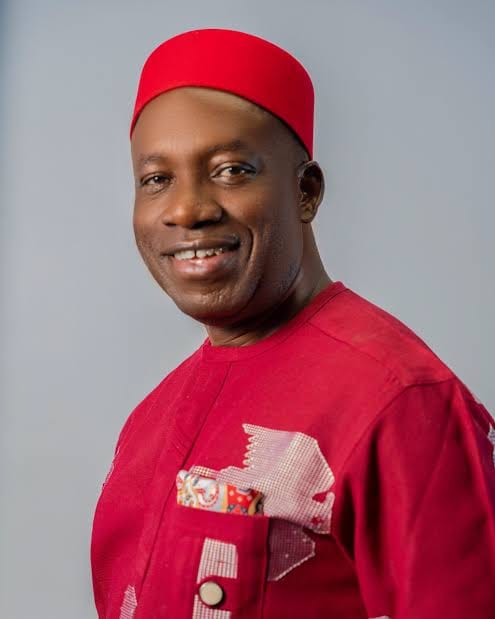
In 24 hours, the Anambra State Government issued two conflicting directives on grassroots elections, moving from a rescheduling order to an indefinite suspension, a shift that has thrown Town Unions and traditional institutions into confusion and raised deeper questions about democracy at the grassroots on the eve of the 2027 general elections, writes from Abuja, by Ekuson Nw’Ogbunka, Our Managing Editor. .
The ontroversy began with the
latest document.
On 8th October, 2026, the Ministry of Local Government, Chieftaincy and Community Affairs, in a letter Ref: MLGCCA/CM/026/T.3/220 signed by the Commissioner, Vin Ifeanyi Ezeaka, Esq, announced a blanket suspension of all Town Union Government elections scheduled for December 2026, January and February 2027.
Addressed to Presidents-General, Youth Leaders and Women Leaders, the letter states: “Furtherance to our letter of October 7, 2026, I wish to convey the decision of the State Government to suspend all Town Union elections … All Town Union elections scheduled from December 2026 and upwards are hereby suspended till further notice.”
Crucially, paragraph 3 adds: “Please note that this letter overrides our earlier correspondence dated 7th October, 2026.” The directive was copied to the Commissioner of Police, Director of DSS, Special Adviser on Community Security and Mayors of LGAs for “strict compliance.”
This is a more severe directive than what came a day earlier
On 7th October, 2026, the same Ministry, in a letter Ref: MLGCCA/CM/026/T.3/219 signed by Tony Onyekamelu, HOD Town Union Matters for the Commissioner, had issued the first order. That one was broader – it suspended both Traditional Rulership and Town Union elections for the same period, but it gave a reason and a rescheduling plan.
Paragraph 2 of the 7th October letter said: “The suspension is necessitated by the political campaigns and General elections scheduled for January, 2027 and February, 2027.”
It then directed that: Communities whose election falls in December 2026 should reschedule and conduct such elections on or before November 2026, with handover on the exact tenure expiration date; while those that fall in January or February 2027 should reschedule for Easter 2027.
The contradiction and why it matters
Putting the two together, the state government moved in 24 hours from “reschedule, don’t cancel” with a stated reason, avoiding clash with political campaigns, to”suspend indefinitely till further notice” with no reason given, covering all elections from December 2026 upwards.
This reversal creates three critical issues for analysis:
Policy inconsistency: If the reason was to avoid clash with campaigns, the 7th October solution of shifting December elections to November 2026 and January/February elections to Easter 2027 was logical. The 8th October indefinite suspension abandons that logic. It suggests either poor policy coordination within the Ministry or a hardening of position after the first letter was issued.
Democratic implications: Town Unions are not departments of government. They are autonomous community organizations. An indefinite suspension means incumbent PGs and executives whose tenure expires in December 2026 will continue in office without a fresh mandate, for an unspecified period. In Anambra where PGs are critical for grassroots mobilization, this effectively freezes community leadership.
Political timing: The suspension period, December 2026 to February 2027, is exactly the peak of the 2027 presidential and National Assembly campaigns. This comes at a time Governor Charles Chukwuma Soludo is being positioned as Coordinator of President Bola Tinubu’s re-election campaign in Anambra, a role praised by groups like SEEYATS ’27 which openly said it works with “presidents-general of town unions” to mobilize for Tinubu. Critics will argue that freezing elections keeps a known set of community leaders in place during the most sensitive political window.
A balanced view
To be fair to the government, there is a legitimate administrative argument. Anambra Town Union elections are often acrimonious, leading to factions, court cases, and insecurity. The government has a duty to ensure that community contests do not compound the security burden of a general election. Copying the security agencies shows the state sees this as a security matter.
Furthermore, the government may have realized that rescheduling all December elections to November 2026, as proposed on the 7th, was logistically impossible for many communities within less than two months.
However, good intentions require clear process. A blanket “till further notice” order without a sunset clause, without publishing the legal provision under the Anambra State Traditional Rulers and Town Union Law that empowers such suspension, and without consulting Ndi Igwe and the Anambra State Association of Town Unions (ASATU), weakens its legitimacy.
Conclusion
The two letters tell a story of a government still deciding how to handle grassroots democracy in an election season. The 7th October letter attempted to balance political reality with community autonomy by rescheduling. The 8th October letter chooses control over balance by suspending indefinitely.
For a Soludo administration that prides itself on law, order and progressive governance, the critical test is not just whether it can maintain peace during the 2027 campaigns, but whether it can do so without being seen to stifle the very community democracy that makes Anambra politically vibrant.