








By Ekuson Nw’Ogbunka in Abuja
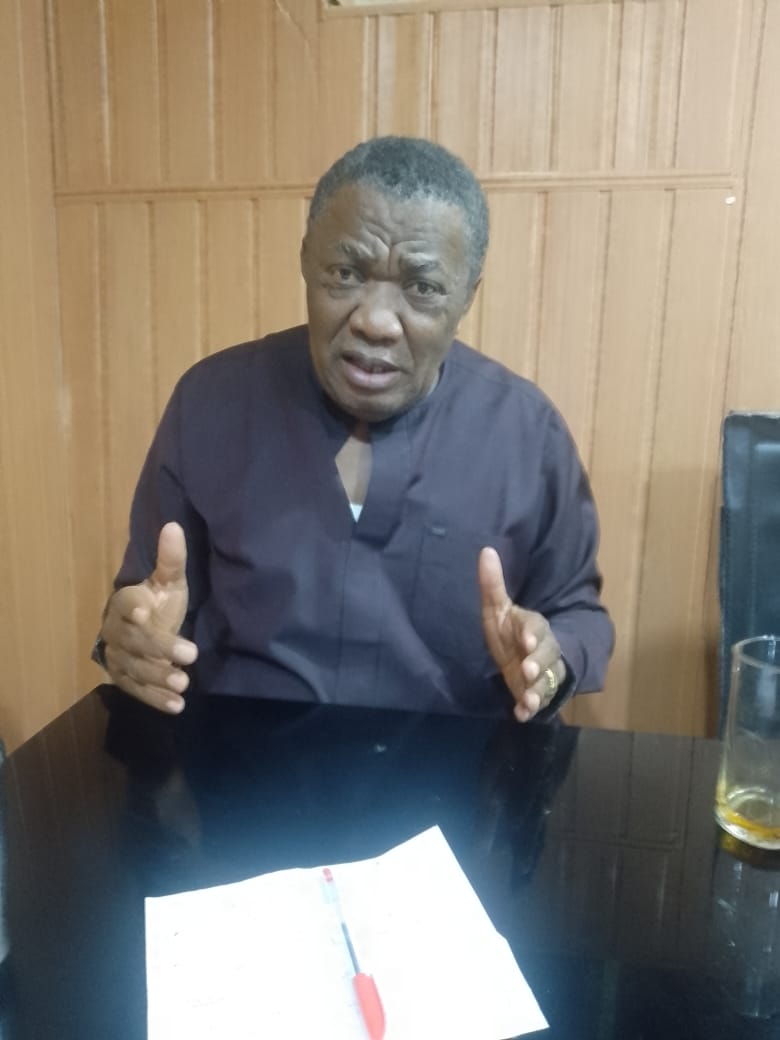
If what an Nnewi in Anambra State-born Prince Orji Nwafor-Orizu, who is the National President of the Society for the Advancement of Democracy (SAD, in Nigeria, is something to go by, Nigeria’s approach to the 2027 general elections is already generating political activity, with presidential and National Assembly aspirants, political parties and their supporters positioning themselves for what promises to be another highly competitive electoral contest. Yet, beyond the growing political mobilisation, he went on, an important question remains: Are Nigerians being presented with competing ideas and workable solutions, or is the campaign environment becoming another contest of personalities, allegations and political rhetoric?
The prince who is also the Principal Partner at Friends Chambers, clearly belongs to the school of thought that believes Nigerian politics needs a stronger dose of issue-based campaigning. His criticism is that politicians frequently spend more time attacking opponents, questioning their credentials and boasting about electoral strength than explaining how they intend to address the country’s problems.
There is considerable merit in that argument. Elections are ultimately about choices, and voters cannot make informed choices if candidates do not sufficiently explain their programmes. A presidential campaign, for instance, should provide concrete answers on how a candidate intends to tackle unemployment, insecurity, inflation, education, healthcare, infrastructure, energy and productivity. Broad promises such as transforming Nigeria from consumption to production may sound attractive, but voters reasonably deserve to know the policies, institutional reforms, financing mechanisms and timelines behind such promises.
However, it would also be unfair to conclude that nothing resembling policy debate exists in the current political environment. Nigerian politicians and parties have presented various economic, social and institutional proposals, while debates over the performance of the present administration, the removal of subsidies, taxation, economic reforms and governance have themselves become political issues. The more useful criticism, therefore, is not that politicians have offered no ideas, but that the ideas often struggle to receive the same attention as personalities, political alliances and attacks.
Nwafor-Orizu’s criticism of negative campaigning also deserves a balanced interpretation. Political campaigns everywhere involve criticism of opponents. Questions about a candidate’s record, competence, qualifications or past decisions are legitimate parts of democratic scrutiny.
The problem arises when such criticism becomes the campaign itself. If a candidate spends most of his or her time explaining why an opponent is unfit for office without equally explaining why voters should support them, the electorate may end up knowing more about the candidate’s opponent than about the candidate’s own programme.
The discussion about political alliances, particularly across party lines, further illustrates the complexity of Nigerian politics. Politicians can support candidates or governments outside their immediate party structures for strategic, ideological or governance-related reasons. Such alliances are not necessarily evidence of inconsistency.
But they become problematic when voters are not told the principles or interests underpinning them. Ultimately, political cooperation should be judged by its implications for governance rather than simply by the identities of the politicians involved.
Another important issue raised by Nwafor-Orizu is the belief among some Nigerians that their votes do not count. This perception is one of the greatest challenges confronting democratic participation, because it can encourage voter apathy. Yet the answer cannot simply be to tell citizens to vote. Political parties, candidates, election officials, security agencies, civil society organisations and voters all have roles to play in ensuring that the electoral process is credible.
Political parties, in particular, must do more than mobilise supporters during campaigns. They need properly trained polling-unit agents, effective result-management structures and credible mechanisms for documenting and challenging irregularities. At the same time, electoral integrity cannot depend solely on the ability of individual parties to protect their votes. The institutions responsible for conducting elections must provide a process in which citizens can reasonably trust that their votes will be accurately counted and reflected in the final result.
Nwafor-Orizu’s argument that voters should accept responsibility for their choices is also worthy of consideration, although it requires some qualification. Citizens should indeed scrutinise candidates before voting and should hold elected officials accountable afterwards. But electoral outcomes can also be influenced by factors beyond individual voters, including institutional weaknesses, misinformation, vote buying, insecurity, administrative failures and unequal political resources. Responsibility for democratic outcomes must therefore be shared rather than placed entirely on the electorate.
The most important takeaway from the interview is perhaps the distinction between campaigning against someone and campaigning for something. A healthy democracy requires both scrutiny and alternatives. Voters need to hear why an incumbent or opponent should be rejected, but they equally need to hear why the alternative deserves their confidence.
As the 2027 elections approach, Nigerian political parties therefore face a significant test. They can continue with personality-driven politics, political boasts and endless accusations, or they can use the campaign period to present competing visions for the country. The latter would give Nigerians something more valuable than political excitement: a genuine basis for choosing their next leaders.
Ultimately, Nwafor-Orizu’s criticism should not be interpreted simply as an attack on politicians or one political camp. It is better understood as a challenge to all political parties and candidates: move beyond slogans, personalities and insults; explain the problems you intend to solve, demonstrate how you intend to solve them, and give Nigerians enough information to make an informed choice.
The real measure of the 2027 campaign should therefore not be who insults an opponent most effectively or who boasts most confidently about victory, but who can convince Nigerians, with credible ideas and practical plans, that they deserve their votes.