







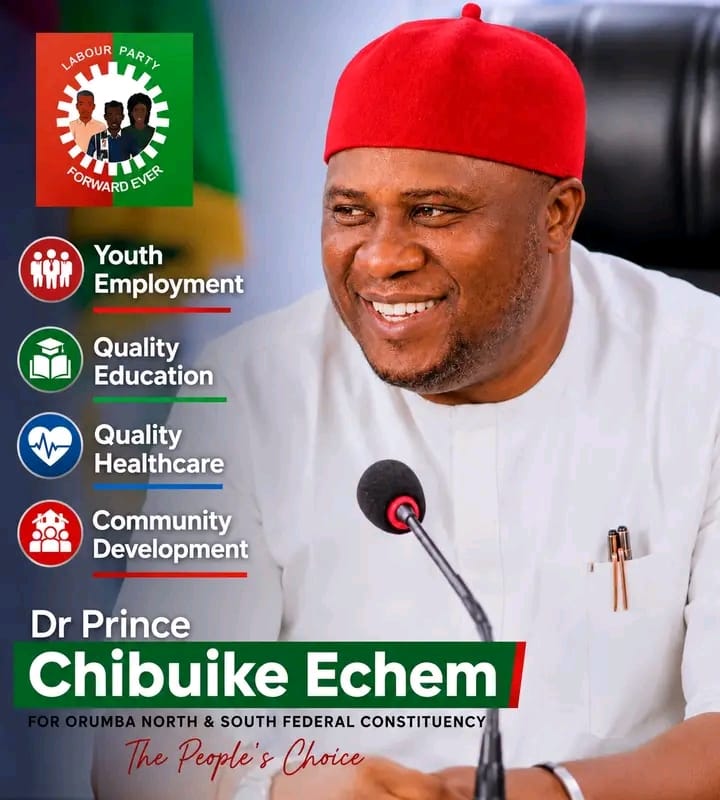
In the build-up to the 2027 general elections, the race for who represents Orumba North/South Federal Constituency in the House of Representatives is already gathering momentum. And from the camp of the Anambra State Labour Party, a bold promise has been made.
Prince Chibuike Echem, the party’s flagbearer, has laid out a 6-point agenda he says will redefine representation for Orumba. Framed around jobs, education, health, and accountability, the manifesto seeks to speak directly to the pains of youths, women, and communities that have long complained of neglect.
But beyond the promises, the real question is: Can this agenda translate from paper to policy? This analysis by Ekuson Nw’Ogbunka, Our Managing Editor, on Thursday, examines the substance, feasibility, and political weight of Echem’s pledge.
Setting the Tone: An Idle Mind Is the Devil’s Workshop
Opening his address, Echem anchored his campaign philosophy on productivity. “If one has something doing, he will be busy and be taking responsibility of his family,” he said. The quote is familiar, but in Orumba where youth unemployment and rural-urban migration are rising, it resonates. He is positioning himself not as a politician of handouts, but as one who wants to create systems.
Youth and Women Employment through Investment Attraction
The first pillar is direct: jobs. Echem promised to use “quality bills and motions” to attract investments that will employ youths and women. This means legislative advocacy for federal projects, PPPs, and SME hubs in Orumba. For a constituency with huge agricultural and artisanal potential, attracting agro-processing plants or tech training centers could be a game changer, if lobby power in Abuja matches the promise.
Why Employment Matters Now
Orumba North/South has a large youth population but limited industries. Many graduates leave for Onitsha, Lagos, or abroad. By tying employment to legislation, Echem is signaling he understands that constituency projects alone cannot solve joblessness. The test will be his ability to influence budgetary allocations and attract federal agencies to site projects in the area.
Structured Youth Empowerment
Beyond jobs, Echem spoke of “meaningful trainings and workshops” that will ensure youths “start doing one thing or the other.” This moves past the usual token empowerment of sharing generators. The emphasis on skills suggests vocational centers, digital skills, and cooperative funding. If well-structured, this could reduce crime and idleness that he referenced.
The Gap in Past Empowerment Programs
Previous reps have done empowerment, but critics say many beneficiaries resell items. Echem’s promise will be judged on sustainability. Will there be post-training funding, mentorship, and market linkage? Without that, workshops risk becoming political rallies.
Quality Education
Echem’s third promise is to “promote education” by ensuring teachers are “trained and retrained to meet up with the rest of the Minister of education today.” This is critical. Many public schools in Orumba lack STEM teachers and digital literacy. A federal lawmaker can push for TETFund interventions, UBEC matching grants, and federal teacher training programs to be domiciled in the constituency.
Education as a Long-Term investment
If done, this will benefit “everyone,” as he noted. An educated constituency produces better health workers, entrepreneurs, and civil servants. The challenge is ensuring federal presence — like a Federal Science College or skill acquisition institute — is attracted to Orumba to institutionalize the gains.
Quality Healthcare and Closer Access
On health, Echem promised to ensure doctors are “trained and retrained,” and that health centers and hospitals are “equipped adequately and made closer to the people.” This speaks to two issues: manpower and infrastructure. Orumba has PHCs, but many lack drugs, power, and personnel.
LegislativeTools for Health
As a federal lawmaker, Echem can sponsor bills for health insurance expansion, push for NPHCDA and Federal Ministry of Health projects, and attract a Federal Medical Center or diagnostic center. “Closer to the people” suggests advocacy for more PHCs and mobile clinics, which aligns with rural realities.
Community Development via Town Halls
Echem promised regular town hall meetings “to know the needs of communities.” This is a direct response to the complaint that reps become invisible after elections. If institutionalized quarterly, town halls could make budgeting more participatory and reduce the disconnect between Abuja and the villages.
The Politics of Listening
Town halls also serve a political purpose: they build trust and give the lawmaker data to lobby for specific projects. For Orumba’s autonomous communities with different priorities, this approach could help ensure equity in project distribution.
Transparency and Accessibility
The final pledge is perhaps the most important: “keeping all my offices and myself available for the constituents.” In a system where many reps are Abuja-based, this promises open-door governance. It implies constituency offices that actually function, with staff who report back.
Why Transparency Will Define His Tenure
Voters are tired of opaque peomised projects. If Echem publishes quarterly reports of motions, bills, and projects, he sets a new standard for LP representation in Anambra. Transparency could be his biggest differentiator in 2027.
The Feasibility Question
The agenda is ambitious, but one man in the House cannot do it alone. Success will depend on three things: his committee placements, relationship with the executive, and ability to work across party lines. Labour Party currently has limited federal presence, so coalition-building will be key.
What this Means for Orumba North/South
The constituency needs more than symbolism. It needs jobs, functional primary health centres, and schools that compete nationally. Echem’s agenda directly addresses those gaps. If he wins and delivers even 60% of this, Orumba will feel a shift. If not, it becomes another campaign document.
From Promise to Policy
Dr. Prince Chibuike Echem has set the bar early. His 6-point agenda is clear, people-focused, and legislative-driven. The next two years will determine if it remains rhetoric or becomes law. For Orumba North/South voters in 2027, the choice may come down to who offers not just promises, but a plan, and the will to execute it.