






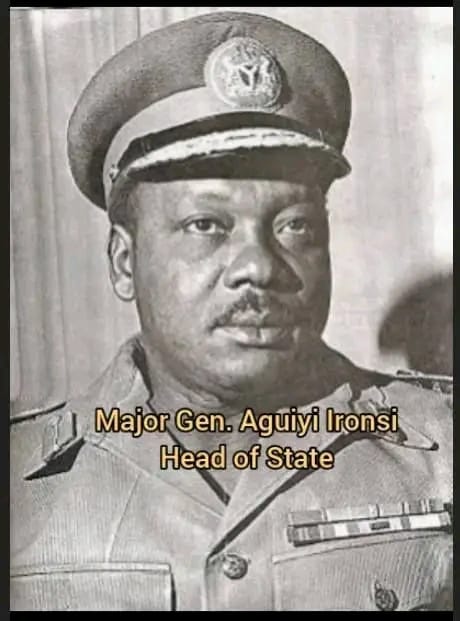
Curled from Mbet Samuel, former Nigeria under-17 striker, B.A. History & International Studies, Ekuson Nw’Ogbunka, Our Managing Editor, writes that sixty years ago today, Nigeria did not just lose a Head of State. It lost the fragile trust holding its regions together. The killing of Major General J.T.U. Aguiyi-Ironsi and the massacre of over 200 Igbo soldiers and 30,000 Igbo civilians in the North on 29 July 1966 was presented as revenge for January. In reality, it was the moment Nigeria’s fault lines became trenches. What followed was not closure, but a civil war that would claim over 3 million lives.
On 29 July 1966, Northern soldiers staged a counter-coup. Aguiyi-Ironsi, Nigeria’s Head of State, was killed. The violence did not stop at the barracks. In cities across the North, Igbo civilians were hunted, killed, and driven from their homes. Over 1 million fled east.
To understand why, we must go back seven months. On 15 January 1966, young officers carried out Nigeria’s first military coup. The targets were political and military leaders: Prime Minister Tafawa Balewa, Northern Premier Ahmadu Bello and his wife, Western Premier Samuel Akintola, Finance Minister Festus Okotie-Eboh, Brigadier Samuel Ademulegun and his pregnant wife, and other officers.
Notably, no top Igbo political leader was killed. President Nnamdi Azikiwe was abroad on medical leave. Senate President Nwafor Orizu, Eastern Premier Michael Okpara, Mid-West Premier Dennis Osadebay, and Major General Aguiyi-Ironsi survived.
The coup plotters were led predominantly by young Igbo officers: Chukwuma Kaduna Nzeogwu, Emmanuel Ifeajuna, Humphrey Chukwuka, Donatus Okafor, Christian Anuforo. They were joined by Fola Oyewole, Adewale Ademoyega, Ganiyu Adeleke, Daramola Oyegoke and others. Their stated motive was to end corruption.
Perception, however, overtook intent. In a country already anxious about ethnic balance, the ethnic identity of the plotters mattered more than their manifesto. The North quickly labeled it “the Igbo coup.”
After the coup collapsed, Aguiyi-Ironsi, an Igbo, emerged as Head of State. He failed to prosecute the January plotters under military law. That inaction was read in the North as complicity, whether fair or not.
Then came Decree No. 34. Aguiyi-Ironsi abolished the regional system for a unitary government. For many Northern elites, this confirmed their fear: that power was being centralized under an Igbo-led federal government.
Personnel decisions deepened the suspicion. Within two months, 21 majors were promoted to lieutenant colonel. Eighteen were Igbo. In a military already fractured by ethnicity, the optics were catastrophic.
Anger calcified into resolve. By late July, Northern officers concluded that January had to be “avenged” and the federation “corrected.” The counter-coup of 29 July was their answer.
The counter-coup was led by Northern soldiers who would later dominate Nigerian public life: Murtala Muhammed, Ibrahim Babangida, Muhammadu Buhari, Sani Abacha, Theophilus Danjuma, Martin Adamu, Buka Suka Dimka, and others. Lieutenant Colonel Yakubu Gowon emerged as Head of State.
The violence was not limited to the palace. In the barracks and on the streets, over 200 Igbo soldiers were killed. In markets, schools, and neighborhoods across Northern cities, over 30,000 Igbo civilians were massacred.
The event became known as the July Rematch or Northern Counter-Coup. It is regarded as the bloodiest coup in African history and one of the bloodiest in the world. More important than the statistics was the message it sent: the center could no longer hold.
The mass killings triggered an exodus. Over 1 million Igbos fled the North for the Eastern Region. Communities that had lived together for decades were suddenly segregated by fear and grief.
That exodus changed politics. With their people back in the East and no confidence in federal protection, Eastern leaders began to question the viability of Nigeria itself. The road to secession shortened.
Eight months later, in May 1967, the East declared the Republic of Biafra. The Nigerian Civil War began. It would last three years and claim over 3 million lives, mostly through starvation and disease.
Viewed critically, July 1966 was not just revenge. It was a contest over the Nigerian state: federalism vs. unitary, regional autonomy vs. central control, ethnic security vs. national integration. The counter-coup settled none of these. It militarized them.
The legacy endures. January taught Nigerians that coups could remove governments. July taught them that coups could also target ethnic groups. That lesson has shaped military politics, security doctrine, and inter-group relations for six decades.
Sixty years on, the task is not to refight 1966, but to learn from it. Justice requires acknowledging all victims. Governance requires building institutions that do not collapse when one group feels threatened. And nationhood requires a deliberate effort to turn memory into warning, not into the next cycle of violence.
.