










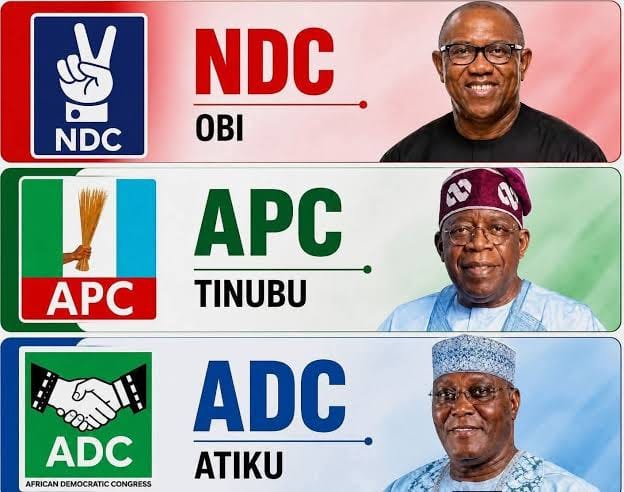
Here, Ekuson Nw’Ogbunka takes a look at the declaration of the African Democratic Congress (ADC), that its push to build a broad opposition coalition ahead of 2027 remains alive, even after high-profile exits threatened to derail the project. National Publicity Secretary Mallam Bolaji Abdullahi insists the door is still open, and that unity offers the best chance of dislodging President Bola Ahmed Tinubu and the APC.
.
The timing matters. The statement comes weeks after former Anambra Governor Peter Obi and former Kano Governor Rabiu Musa Kwankwaso walked away from earlier coalition talks. Their departure exposed the fragility of personality-driven alliances in Nigeria, where egos, regional calculations and 2023 grievances still shape negotiations.
Despite the setbacks, the ADC has moved quickly to present a ticket. It has named former Vice President Atiku Abubakar as presidential candidate and former Rivers Governor Rotimi Amaechi as running mate, and has submitted their particulars to INEC. The move signals intent, but also risks reinforcing the perception that the opposition is recycling familiar faces.
Abdullahi’s core argument is economic. He frames the 2027 contest as a referendum on hardship, citing rising living costs, insecurity and food shortages. He referenced a World Food Programme assessment putting over 17 million Nigerians in conflict-affected northern states at risk of acute food insecurity, blaming APC policies for worsening the crisis.
That line of attack resonates. Nigerians are feeling the pinch of fuel subsidy removal, naira floatation and inflation. If the election is fought on kitchen-table issues, the APC will be on the defensive. But the ADC must do more than name problems. Voters will ask what a Atiku-Amaechi administration would do differently, and how quickly.
The ticket itself is a study in contradictions. Atiku represents continuity of PDP-era politics and northern establishment power. Amaechi brings South-South experience and a reputation for infrastructure delivery as Minister of Transportation. Together they cover two major zones, but they also carry baggage: allegations of elite politics and limited grassroots appeal among younger voters.
On strategy, Abdullahi says the ADC will “match the ruling party in whatever they bring” while staying within the law. That is code for preparing against vote-buying and manipulation. It is a realistic admission that 2027 will not be won on ideas alone. Yet promising to fight fire with fire raises questions about how far the party will go, and whether it can avoid the same accusations it levels at the APC.
The ADC is also leaning into governance reforms. It backs IPAC’s call for a new process of appointing the INEC chairman, arguing that presidential discretion creates suspicion. It further wants INEC to take over local government elections, saying state commissions have become rubber stamps for governors. Both proposals are sound in principle and would strengthen democracy if pursued.
However, the party undermines its reform credentials with some of its rhetoric. The claim that former Kaduna Governor Nasir El-Rufai is being detained as a “political prisoner” until 2027 is politically convenient but lacks evidence in the public domain. Repeating it risks turning a legal matter into a campaign slogan and distracts from policy debate.
Similarly, dismissing petty trading as a solution to unemployment — “we are not going to ask people to be selling akara and kuli-kuli” — plays well on social media, but offers little detail. The ADC promises to support failing businesses and reduce cost of living, but has not outlined how it will fund subsidies, manage debt, or reform the same structural issues the current government is grappling with.
On security, the party’s focus on prevention over rescue is the right emphasis. Welcoming the rescue of kidnapped children in Oyo while demanding that kidnappings be stopped in the first place frames the ADC as thinking beyond headlines. Extending that logic to Kwara, Borno and other hotspots will require a clear plan for policing, intelligence and community engagement, not just slogans.
The coalition question remains the biggest variable. Abdullahi says “the window has not closed,” but windows close fast in Nigerian politics. Obi’s Labour Party and Kwankwaso’s NNPP still command significant followings. Without them, the ADC-Atiku-Amaechi ticket faces an uphill battle in the South East and parts of the North West.
A broader coalition would help, but it would also require painful compromises on zoning, power-sharing and candidate selection. The ADC’s decision to unveil its own ticket first may be read as confidence, or as preempting other parties. Either way, it makes later negotiations harder.
For the APC, the ADC’s early moves provide a target. The ruling party will argue that Nigerians should not return to the past, and will point to ongoing reforms, infrastructure projects and security operations. Whether that message lands depends on whether economic indicators improve before 2027.
Ultimately, the ADC’s assessment is partly correct: dissatisfaction with economic conditions creates an opening. But an opening is not a victory. To unseat an incumbent, the opposition needs unity, credible alternatives, grassroots structure, and protection of the vote. Right now it has one of those, and is working on the others.
The next 18 months will test whether the ADC can turn this “fresh move” into a movement. If it builds policy depth, manages egos, and delivers a convincing economic plan, it could make 2027 competitive. If it relies only on anger at the status quo, it risks repeating the fragmentation that handed the APC victory in 2023.