






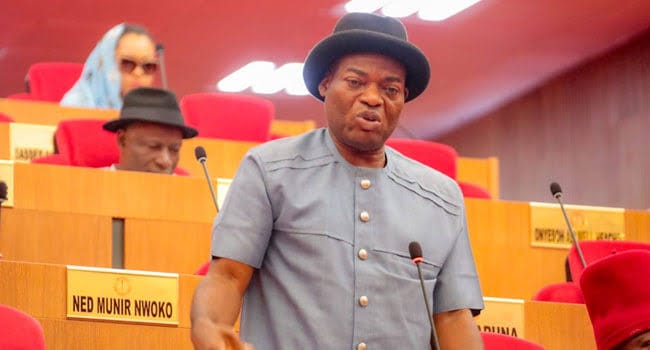
•Will the call for rehabilitation translate into action?
Senator Tony Nwoye’s motion seeking urgent rehabilitation of the Onitsha–Iyiowa–Odekpe–Atani–
The motion, presented under Orders 41 and 51 of the Senate Standing Orders, highlights the reported deterioration of the highway, which links the South-East and South-South geopolitical zones through Ogbaru Local Government Area of Anambra State, analyses, Ekuson Nw’Ogbunka, Our Managing Editor.
.
Its central argument is straightforward: a road of strategic economic importance should not remain in a deplorable condition for decades without comprehensive intervention.
Yet, beyond the urgency of the appeal, the proposal raises broader questions about federal infrastructure management, preventive maintenance, funding priorities and the capacity of public institutions to convert legislative resolutions into tangible improvements.
The Cost of a Failing Highway
The reported increase in travel time provides a useful starting point for understanding the problem.
According to the motion, a journey of approximately 70 kilometres from Onitsha through Ogbaru to Ndoni, which should ordinarily take about an hour, now takes nearly two hours.
If the estimate reflects prevailing conditions, the additional time represents a substantial burden for commercial drivers, traders, commuters and businesses operating along the route.
Longer journeys can increase fuel consumption, vehicle operating costs and the time required to transport goods. Delays may also disrupt business schedules and reduce the efficiency of agricultural supply chains.
These costs are rarely confined to transport operators. Depending on market conditions, some may be transferred to consumers through higher prices for goods and services.
The deteriorating highway is therefore not simply a local inconvenience. Its condition potentially affects the economic relationships connecting communities, markets and commercial activities across state boundaries.
Nevertheless, the precise scale of the economic losses would require supporting data on traffic volumes, transport costs, accident records and business activity along the corridor.
Strategic Importance, Persistent Neglect
One of the strongest arguments in the motion is the highway’s dual role as a regional transport link and an access route serving oil and gas activities in the Ogbaru oil belt.
Roads supporting economically significant areas should be assessed not only in terms of their immediate users but also by their contribution to wider economic activity.
A poorly maintained road can undermine the movement of goods and workers, increase logistics costs and make commercial operations less predictable. These consequences can affect agricultural production, local trade and investment decisions.
The motion states that the highway was partially constructed in the late 1980s and has since suffered decades of neglect without any major rehabilitation.
If substantiated by the road’s maintenance and construction records, that history would raise legitimate questions about the adequacy of previous maintenance arrangements and the prioritisation of infrastructure spending.
However, identifying decades of deterioration does not, on its own, establish which institutions were responsible for particular failures or whether earlier interventions were attempted. A comprehensive review of the road’s history and maintenance records would help establish those facts.
The immediate priority remains to determine the extent of the damage and the most effective way to restore the highway.
Emergency repairs versuscomprehensive reconstruction
The Senate’s proposed two-stage approach is one of the more practical elements of the motion.
First, it calls for emergency palliative repairs by the Federal Roads Maintenance Agency (FERMA), or alternatively the South East Development Commission or the Federal Ministry of Works.
Second, it urges the Federal Ministry of Works to undertake comprehensive rehabilitation and reconstruction through a special intervention programme or another appropriate funding arrangement.
The distinction is important.
Palliative repairs may address the most dangerous potholes and failed sections, helping to reduce immediate risks while a larger project is being prepared. But where the underlying pavement structure, drainage system or road foundation has deteriorated extensively, surface repairs alone may provide only temporary relief.
Comprehensive rehabilitation would therefore require an engineering assessment to determine whether particular sections need resurfacing, structural repairs, drainage improvements or complete reconstruction. The relevant authorities would also need to establish the project’s estimated cost, funding source, procurement arrangements and implementation schedule.
Without these details, the call for urgent rehabilitation risks remaining a statement of intent rather than an executable infrastructure programme.
Funding and Institutional Coordination
The motion’s reference to FERMA, the South East Development Commission and the Federal Ministry of Works reflects the need to identify an appropriate institutional route for the intervention.
However, alternative funding or implementation proposals must be translated into clear administrative arrangements. The responsible agency would need the appropriate authority, technical capacity and funding to carry out the work.
The Federal Ministry of Works would also need to clarify how the project fits into its existing rehabilitation priorities and whether a special intervention programme is feasible. Similarly, any proposed involvement by the South East Development Commission would require confirmation of its applicable mandate, project eligibility and available resources.
The Senate’s call for the Committees on Works and Appropriations to ensure adequate budgetary provision is therefore significant. Yet, budgetary provision alone would not guarantee delivery. Funds must be appropriately released, contracts properly administered and works independently monitored. The experience of infrastructure projects more generally demonstrates why implementation arrangements matter as much as initial approvals.
The Four-Week Assessment: An opportunity for accountability
The proposed mandate for the Senate Committee on Works to inspect the highway, engage stakeholders and report within four weeks provides a potential mechanism for moving the issue beyond general complaints.
An effective assessment should identify the most severely damaged sections, document the condition of drainage and pavement structures, examine safety risks and establish the likely scope of emergency repairs. It should also distinguish between sections that can be restored through routine or palliative maintenance and those requiring major rehabilitation or reconstruction.
Engagement with residents, transport operators, community representatives and businesses could help the committee understand how road failures affect daily movement and commercial activities.
The resulting report would be more useful if it contained specific recommendations, cost estimates where available, prioritised interventions and clear proposals for implementation.
Public disclosure of the committee’s findings would further strengthen accountability by allowing road users to understand the nature of the problem and the proposed response.
Safety and security cannot be overlooked
The motion also raises concerns about vehicle breakdowns, road traffic accidents and security risks associated with motorists becoming stranded.
These concerns reinforce the need to prioritise immediate repairs at the most hazardous locations rather than wait for every aspect of a comprehensive reconstruction programme to be concluded.
At the same time, road rehabilitation should not be reduced to pothole filling alone. Drainage failures and erosion can quickly damage repaired surfaces if their underlying causes are not addressed.
A durable intervention would combine immediate safety measures with engineering solutions designed to reduce the likelihood of repeated deterioration.
What the motion does—and does not guarantee
The Senate’s intervention can help elevate the highway’s rehabilitation on the public agenda and place pressure on relevant authorities to respond.
It can also establish a basis for legislative scrutiny of funding, project planning and implementation.
However, a motion calling for action should not be confused with proof that the project has been approved, funded or commenced.
The decisive indicators will be the publication of assessment findings, the identification of the responsible implementing authority, the availability of funding and evidence that repair works have begun and are progressing according to an established plan.
The Senate’s oversight role would remain important throughout this process, particularly in tracking compliance with any adopted resolutions and examining delays or implementation challenges.
Conclusion: The measure of success is on the road
Senator Nwoye’s motion has highlighted a road whose reported condition poses challenges for transportation, economic activity and public safety. Its economic significance and role in connecting the South-East with the South-South make a compelling case for a properly planned intervention. But urgency must be matched by technical preparation, funding discipline and sustained oversight.
The proposed four-week assessment offers an opportunity to establish the facts, identify priorities and develop an actionable response. The call for emergency repairs could provide interim relief, while comprehensive rehabilitation would address the underlying infrastructure problems.
Ultimately, the success of the initiative will not be measured by the number of resolutions passed or assurances issued. It will be measured by whether motorists can travel more safely, businesses can move goods more efficiently and communities can rely on a road that is maintained to an acceptable standard.
For the Federal Government and the relevant agencies, the challenge is to turn the Senate’s call into a transparent, adequately funded and sustainable programme that delivers measurable results.