









By Ekuson Nw’Ogbunka in Abuja
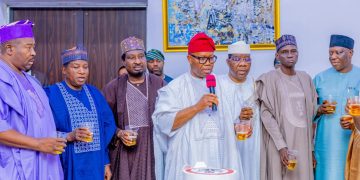
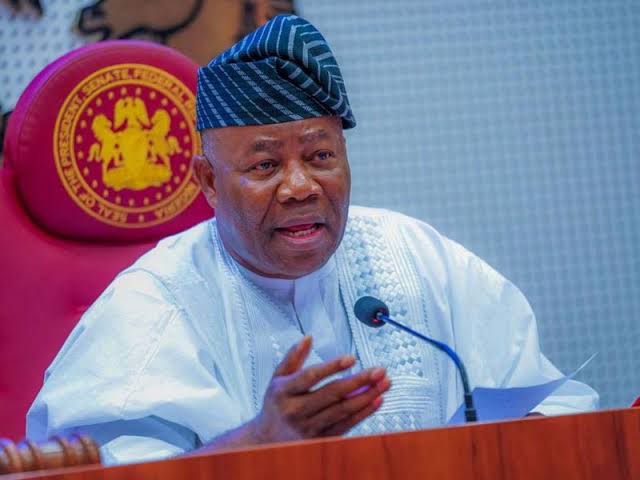
Senator Tahir Monguno’s declaration that there is “no vacancy” in the Senate presidency has given Godswill Akpabio an early political boost ahead of the 2027 elections. Yet, beneath the show of solidarity lies a fundamental question: can today’s senators influence tomorrow’s leadership without appearing to prejudge the choice of a Senate whose members have not yet been elected?
The contest for the presidency of Nigeria’s 11th Senate is already taking shape, even though the 2027 general elections are still ahead. Monguno’s declaration has signalled that Akpabio’s allies intend to begin consolidating support well before the next National Assembly is inaugurated.
Politically, the pronouncement is significant because it projects confidence in Akpabio’s leadership and seeks to establish continuity as the preferred option. In a contest where alliances and numbers often determine outcomes, an early show of support can help an incumbent strengthen relationships and discourage potential challengers.
However, political momentum should not be confused with a guaranteed outcome. The current Senate cannot determine the composition or leadership of the 11th Senate, whose members will emerge from the 2027 National Assembly elections.
Akpabio therefore faces two distinct challenges. First, he must secure re-election to the Senate. Second, he must obtain the support of enough senators in the next Assembly to win another term as Senate President. Success in one contest does not automatically guarantee victory in the other.
The timing of Monguno’s declaration is also noteworthy. It came shortly after Akpabio complained that political opponents were using controversies surrounding his comments during deliberations on a bill concerning attempted suicide to damage his reputation ahead of the leadership struggle. This context suggests that the declaration may also be intended to reinforce his political position against emerging opposition.
Yet, the strategy carries potential risks. Declaring the Senate presidency effectively settled before voters elect the next Assembly could create an impression that the current leadership wants to predetermine a decision that belongs to a future Senate. Such a perception could generate resistance among lawmakers who want the freedom to choose their own presiding officers.
There is, however, another reasonable interpretation. Monguno and other supporters are entitled to express their political preferences, just as other senators may advocate for alternative candidates. Their declaration does not, by itself, prevent future lawmakers from contesting the position or exercising their constitutional responsibilities when the time comes.
The more important issue is whether Akpabio’s record justifies another term. Supporters may highlight legislative activities, cooperation with the Executive and the passage of government-backed legislation. Critics, on the other hand, may question the effectiveness of legislative oversight, the Senate’s independence and its performance in holding the Executive accountable.
These competing perspectives deserve serious consideration. The Senate presidency is not simply a political reward for loyalty or an extension of the incumbent’s influence. It is an office whose occupant has considerable responsibility for legislative business, committee assignments, confirmation proceedings, investigations and the relationship between the National Assembly and the Executive.
Akpabio must therefore demonstrate that his leadership has strengthened the Senate as an independent institution. His ability to maintain constructive relations with the Executive while ensuring effective scrutiny of government policies and expenditure will be central to the argument for continuity. Political endorsements alone cannot settle that debate.
The emergence of possible alternative contenders, including Senator Adams Oshiomhole and Imo State Governor Hope Uzodimma, who is seeking a return to the Senate, further illustrates the uncertainty surrounding the contest. The eventual field of candidates and the balance of political interests will depend on the outcome of the elections and the alliances formed afterward.
Ultimately, Monguno’s “no vacancy” declaration is best understood as an early political signal rather than a settled verdict. Akpabio has gained an opportunity to mobilise support, but his return will depend on electoral success, the composition of the 11th Senate, his legislative record and the confidence he can inspire among his future colleagues. The final decision will belong to the senators elected in 2027, not those who currently occupy the chamber.