

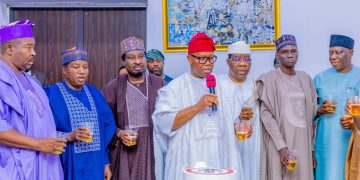









As Nigeria counts down to the 2027 general elections, Orumba North and South Federal Constituency of Anambra State stands at a political crossroads. With promises of genuine representation and sustainable development dominating the discourse, Dr. Odiraa Nnwankwor has positioned himself as the candidate to end years of perceived stagnation. But in a constituency known for rewarding performance over rhetoric, the question is whether vision alone can translate into votes and, more importantly, into results, analyzes Ekuson Nw’Ogbunka, Our Managing Editor over the weekend.
The central thesis of Dr. Nnwankwor’s campaign is political emancipation through effective representation. He argues that for too long, Orumba’s voice has been faint at the national level where budgets, policies, and projects that determine the constituency’s future are decided.
His message directly addresses a frustration common in many federal constituencies: the gap between election promises and post-election delivery. By pledging that “representation should result in tangible benefits,” he is tapping into voter fatigue with symbolic politics.
The emphasis on inclusivity is notable. By naming specific communities, Ndiokpaleke, Onneh, Agbudu, Enugu Umuonyia, Ndiukwuenu and Amaetiti, the campaign signals an intent to decentralize development. This counters the perception that only headquarters towns benefit while rural areas are ignored.
Critically, the promise of “equal attention regardless of location” speaks to a structural problem in Nigerian representation. Constituency projects are often concentrated, leaving other communities feeling disenfranchised. If implemented, this approach could rebuild trust in the democratic process.
Dr. Nnwankwor frames his candidacy around three pillars: accountable leadership, inclusive governance, and advancement. This triad suggests a departure from personality-driven politics toward an issues-based campaign, which resonates with an electorate increasingly demanding performance metrics.
The stated goal is not merely electoral victory but “restoring hope” and “inspiring progress.” This language elevates the contest beyond 2027 to a question of legacy, can one term shift the trajectory of a constituency long described as politically stagnant?
The football analogy introduced in the materials is politically significant. Comparing a strong political structure to a “disciplined defender” suggests that the campaign sees grassroots mobilization and internal cohesion as the key to keeping opponents out.
In Nigerian politics, where defections and last-minute alliances often decide outcomes, a “defensive” structure implies voter education, ward-level organization, and resistance to vote-buying — all critical in Orumba’s terrain.
The reference to Orumba’s political history is equally strategic. The claim that “the people have always rewarded performance, capacity, and loyalty” serves both as flattery and as a challenge. It reminds voters of past representatives who delivered, while implicitly criticizing those seen as opportunistic.
The rejection of “selfish ambition, political opportunism, or political nomadism” is a direct commentary on Nigeria’s culture of party-hopping. In Anambra, where political realignments are frequent, this positions Dr. Nnwankwor as a stable, consistent alternative.
The assertion that “leadership is measured by service, credibility, and commitment” sets a high bar. It shifts evaluation from party affiliation to track record, forcing both the candidate and the electorate to focus on deliverables rather than slogans.
However, a critical lens must ask: what concrete mechanisms will ensure this standard is met? The articles outline the vision but provide limited detail on policy proposals, legislative priorities, or how constituency funds will be managed transparently.
The prediction that “before 12noon in January 2027, Dr. Odiraa Nnwankwor will win all polling units” is bold. Such confidence can galvanize supporters, but it also risks complacency. In a democracy, no victory is guaranteed, and sweeping all polling units would require unprecedented consensus.
That claim must also be tested against Orumba’s voting patterns. The constituency has historically been competitive, with results often determined by local party structures, youth turnout, and the influence of traditional rulers. A win will depend on more than vision.
Another critical point is sustainability. Even with the best intentions, a single House of Representatives member operates within the constraints of national party politics, limited constituency allocation, and bureaucratic bottlenecks. The promise of “long-term results” will require strategic legislative alliances.
The campaign’s strength lies in its narrative of liberation and inclusion. Its weakness, at this stage, is the absence of a detailed roadmap: how will infrastructure, youth unemployment, agriculture, and security in Orumba North and South be addressed specifically?
For voters, 2027 will therefore be a referendum not just on Dr. Nnwankwor, but on the idea of representation itself. Do they want a “defender” who promises to protect constituency interests in Abuja, or do they prioritize other factors like party power at the center?
Ultimately, the Orumba North and South race encapsulates a larger Nigerian dilemma: the demand for performance-driven politics in a system that often rewards patronage. Dr. Nnwankwor has set the tone with a vision of service and emancipation. Whether that vision survives contact with political reality will be decided not by declarations, but by organization, credibility, and the ballot in 2027.