






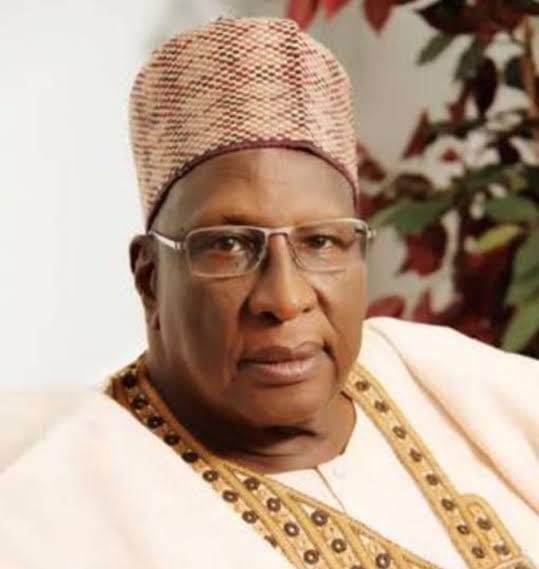
The Northern Senators Forum, has said that the death of Alhaji Bamanga Muhammad Tukur at the age of 90 has robbed the North and Nigeria of one of their most distinguished statesmen, administrators, businessmen and advocates of national unity. For the Northern Senators Forum, his passing marks the end of an era defined by service, institution-building, mentorship and an unwavering belief in Nigeria’s potential, writes Ekuson Nw’Ogbunka Our Managing Editor.
In a condolence message signed by the Chairman of the Northern Senators Forum, Senator Abdulaziz Musa Yar’Adua, the forum described the late Tukur as “a great son of the North and Nigeria,” whose remarkable life represented some of the finest traditions of northern leadership.
Tukur’s public service career was remarkable not merely for the positions he occupied, but for the impact associated with them. As General Manager of the Nigerian Ports Authority from 1975 to 1982, he was part of a generation of public servants entrusted with building and strengthening institutions at a critical period in Nigeria’s development.
His journey took another significant turn in 1983 when he was elected Governor of the old Gongola State. In that capacity, he demonstrated a leadership philosophy centred on institution-building and the welfare of the people, setting standards that, according to the Northern Senators Forum, inspired a generation of public figures.
His contribution to national governance continued at the federal level. Between 1993 and 1995, Tukur served as Minister of Industries, bringing his administrative experience and economic understanding to the task of national development.
Years later, he returned to the centre of Nigeria’s political arena as National Chairman of the Peoples Democratic Party, serving from 2012 to 2014. At a time when political parties faced intense internal pressures and competing interests, his emphasis on discipline, consensus and national unity reflected the principles that had characterised his public life.
But Bamanga Tukur’s story did not begin and end with government or partisan politics. Beyond public office, he emerged as a formidable entrepreneur whose activities extended into manufacturing, agriculture and logistics.
As Chairman of BHI Holdings and DADDO Group, he invested in businesses that created opportunities and contributed to economic activity. His private-sector engagements demonstrated his conviction that national development could not depend solely on government, but required strong indigenous enterprise and productive investment.
His vision was even broader than Nigeria’s economic borders. As Executive President of the African Business Roundtable and Chairman of the NEPAD Business Group, Tukur became an influential voice for African economic integration, intra-African trade and private sector-led development.
Through these continental platforms, he projected Nigeria’s economic interests beyond its shores and advocated stronger cooperation among African businesses and governments. His counsel consequently became valuable not only to leaders in Nigeria but also to policymakers and business leaders across Africa and beyond.
Yet, perhaps the most enduring aspect of Tukur’s legacy was not the offices he occupied, the businesses he led or the honours he received. It was his character.
The Northern Senators Forum remembered him as generous, urbane and guided by integrity and service. These qualities, the forum noted, reflected values deeply associated with the Adamawa Emirate and the wider traditions of northern leadership.
To many who encountered him in politics, business and public life, Tukur was more than an office holder. He was a mentor and elder statesman who understood the importance of dialogue and consensus in a complex and diverse country.
His approach was said to favour reconciliation over confrontation and bridge-building over division. At a time when political differences can easily become personal conflicts, his example offered a reminder that leadership is also about the ability to listen, accommodate divergent interests and pursue common ground.
His traditional titles and national honours further reflected the breadth of his influence. Among the recognitions bestowed on him were the Commander of the Order of the Niger, one of Nigeria’s prestigious national honours, and the Commander of the Order of Mono, reportedly the highest national honour in the Republic of Togo accorded to a foreigner.
For the Northern Senators Forum, these honours represent only part of the story. The greater testimony to Tukur’s life lies in the institutions he served, the businesses he helped build, the people he mentored and the causes he championed.
His death therefore resonates beyond Adamawa State and the North. It is a loss to Nigeria’s political and economic history and to a generation that witnessed his transition from administrator to governor, minister, political leader, entrepreneur and Pan-African advocate.
As the Tukur family, the Fombina Emirate, the Government and people of Adamawa State and Nigerians across the country mourn, attention will inevitably turn to the legacy he leaves behind.
That legacy is one of service without narrow boundaries, from the ports of Nigeria to the corridors of government, from political party leadership to private enterprise and from national development to the wider African economic project.
Bamanga Tukur may have departed at 90, but the ideals associated with his life, patriotism, statesmanship, enterprise, mentorship, consensus and faith in Nigeria, remain a continuing challenge to those who have inherited the responsibility of leadership.
In mourning him, the Northern Senators Forum has prayed that Almighty Allah forgive his shortcomings and grant him Aljannah Firdaus, while giving his family and all those who mourn him the strength to bear the loss.
For a man whose life touched public administration, politics, business and continental development, perhaps the most fitting tribute is that his example should continue to inspire those who believe that public leadership is ultimately about serving people and building a better nation.