









By Ekuson Nw’Ogbunka in Abuja
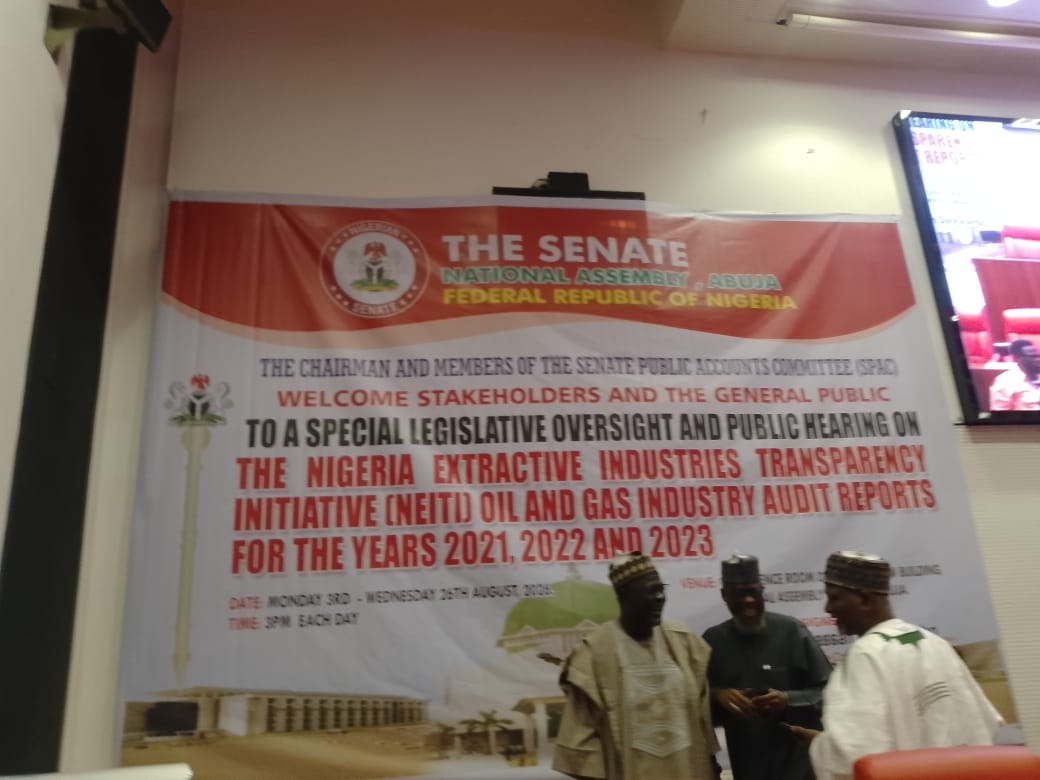
The standoff between the Federal Ministry of Finance and the Nigerian National Petroleum Company Limited over the 2021 to 2023 Oil and Gas Sector Audit report by NEITI has again exposed the fault lines in Nigeria’s public financial management and accountability structure.
On Thursday, Permanent Secretary of the Ministry, Mr. Raymond Omachi, told the Senate Committee on Public Accounts that the Ministry could not answer several queries because NNPCL and other agencies failed to provide the required financial records. The accusation shifts responsibility, but also raises questions about inter-agency coordination at the highest levels of government.
Among the issues flagged by NEITI is the $3 billion pre-export financing loan taken in 2012 to settle subsidy payments. According to the report, the recovery of that loan from monthly Federation revenue under the pre-export financing and Project Eagle agreement remains unclear more than a decade later. That lack of clarity points to weak tracking of public debt and revenue flows.
Another major query concerns $722.6 million paid in 2021 by Nigeria LNG to NNPC as dividends and interest earned by the Federation. NEITI stated that the funds were neither remitted to the Federation Account nor properly accounted for. If true, this represents a significant leakage of revenue that should have gone to fund public services.
The audit also observed that none of Nigeria’s refineries was operational in 2021 despite about N200 billion reportedly spent on them. Coupled with the $221.283 million in overhead costs incurred by NAPIMS in the same year, the findings suggest continued inefficiency and poor value for money in the downstream and upstream sectors.
In his defense, Omachi argued that the Ministry was not directly involved in all the transactions and that the absence of records from NNPCL and NUPRC made it impossible to reconcile the figures. This defense is plausible to an extent, because the Ministry of Finance is not the direct operator of oil assets.
However, the claim also exposes a structural weakness. As the agency constitutionally responsible for managing public finances, the Ministry of Finance cannot afford to be a bystander when billions of dollars are involved. The inability to compel or obtain data from NNPCL suggests either limited authority or limited political will to enforce compliance.
To address the gaps, Omachi said the Ministry has engaged Arthur Andersen LLP to conduct a forensic audit for reconciliation. The decision to bring in external auditors is a positive step toward transparency, but the repeated extensions of the timeline, from six months to one year, undermines public confidence in the process.
Senator Ibrahim Hassan Dankwambo, Chairman of the Senate Committee on Public Accounts, pushed back on the delay. He questioned when the forensic audit report would be ready and insisted that NNPCL and NUPRC must appear alongside the Ministry to provide direct explanations.
Dankwambo also reminded Omachi of the powers vested in the Ministry to compel agencies to produce documents and attend hearings. His position highlights a critical point: oversight cannot work if the lead financial agency treats itself as disconnected from the operations of revenue-generating entities.
The Chairman’s call for a joint session is pragmatic. Having the Ministry of Finance, NNPCL, NUPRC and other relevant agencies in one room would allow for real-time clarification and reduce the cycle of blame-shifting that has characterized previous hearings.
Beyond the immediate queries, the NEITI report touches on issues of national and international interest. Oil and gas revenues remain Nigeria’s primary source of foreign exchange, and any opacity in how they are managed affects investor confidence and Nigeria’s standing with bodies like EITI.
Dankwambo was right to note that these matters are being watched beyond Nigeria’s borders. The global extractive industry community expects timely, credible reporting and remediation of audit findings. Failure to do so risks reputational damage and could affect future financing and partnerships.
A balanced view requires acknowledging that both the Ministry and NNPCL have roles to play. NNPCL must improve record-keeping and responsiveness to oversight requests. The Ministry of Finance must assert its coordinating mandate and ensure that no agency is too big to account.
Ultimately, the $3 billion loan question, the $722.6 million NLNG dividend, the N200 billion refinery spend and the NAPIMS overheads are not just accounting entries. They represent resources that could have built schools, hospitals and infrastructure.
Until the forensic audit is completed and the agencies appear together before the Senate, Nigerians are left with allegations, counter-allegations and unanswered questions. As Dankwambo put it, “All of us have no other country except Nigeria.” That reality should compel both the Ministry and NNPCL to prioritize transparency over institutional defensiveness.