
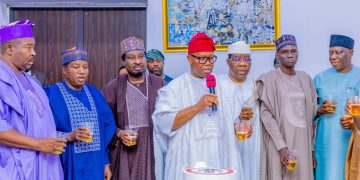




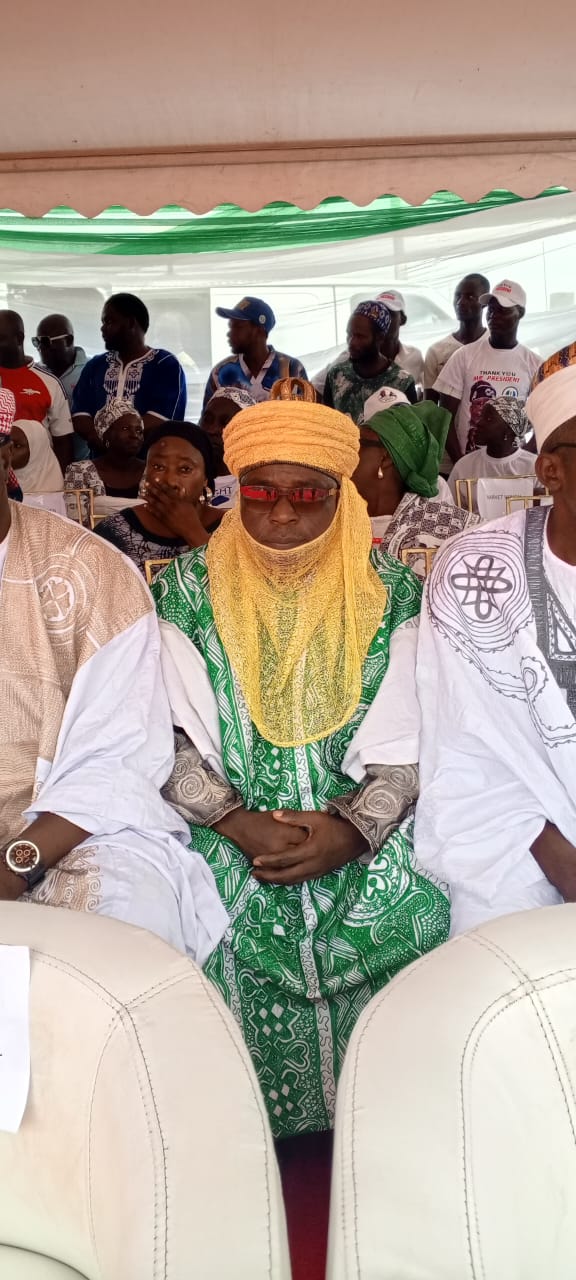
In this piece, Ekuson Nw’Ogbunka Our Managing Editor writes that in Idu-Koro, the host community of Idu Industrial Area in the Federal Capital Territory (FCT), the talk in village squares and motor parks is no longer about abandoned promises. It is about tarred roads, solar lights, and a Minister who shows up. Chief Bawa Mohammad Makama, the traditional ruler and Asugeri of Idu-Koro, put it plainly last week: “Since his inception as the Minister, he has made roads and other infrastructures available, almost every nook and cranny of the Centre of Unity, and for that, we are inviting him to take the title of Sardauna of Idu-Koro.” Bawa was speaking of Barr. Ezenwo Nyesom Wike, the FCT Minister. For residents who have watched Abuja grow for decades, the feeling is that the capital is finally wearing the face it deserves.
The Asugeri Idu, Chief Makama’s commendation came on the heels of weeks of project commissioning by President Bola Ahmed Tinubu, represented by Senate President Godswill Obot Akpabio, even as he is inviting the Minister to come to the ancient community of Idu-Koro to be honored with the title of Sardauna of Idu-Koro. Across the FCT, ribbon-cuttings have become a near-daily affair; roads, bridges, schools, health centers. The message, the royal father said, is clear: Wike has kept the “Mr. Project” name he earned as Governor of Rivers State, and he has brought it to Abuja.
The evidence is closest to home in Idu-Koro. The reconstruction of the Dei-Dei to Life Camp road, which passes directly through the Asugeri Idu’s community, has ended years of gridlock and dust. For traders, farmers, and artisans, travel time has dropped and business has picked up. Solar street lights now line stretches that were once dark at night, improving safety and extending economic hours.
But Idu-Koro is just one address in a citywide overhaul. In the last few months, the Minister has commissioned the full rehabilitation of the Outer Southern Expressway, OSEX, from Villa Roundabout to Ring Road I. The 15-kilometer stretch, long a nightmare for commuters, now moves traffic with ease and has decongested the city center.
Equally significant was the completion and commissioning of the Wuye and Guzape Districts’ road networks. These arterial roads, abandoned for years, are now opening up new districts for residential and commercial development. Property values are rising, and investors who had shelved plans are returning.
The arterial road N20 from Northern Parkway to the Outer Northern Expressway, ONEX, was also delivered. It connects Mabushi, Jahi, and Katampe, providing an alternative route that has eased pressure on the 3rd Avenue corridor. For residents in those axis, the daily commute is no longer a battle.
In Bwari Area Council, the 11-kilometer A2 to Pai road was commissioned, while in Gwagwalada, the 5-kilometer Kwaita-Yebu road brought relief to rural dwellers. The Minister also delivered the Kabusa-Takushara-Apo road in Abuja Municipal Area Council, linking satellite communities directly to the city center.
Beyond roads, Wike has prioritized light. The FCT Administration (FCTA), under his directive, has installed thousands of solar-powered street lights across the six area councils. From Karu to Kwali, from Abaji to Gwagwalada, communities that once went dark at 6pm now have illumination, a critical step in fighting crime and boosting night economic activity.
Education and health have not been left behind. The Minister commissioned the rehabilitation of several schools and primary health centers across the territory, including the upgraded Gwarimpa General Hospital and the renovation of LEA schools in rural communities. The goal, officials say, is to make public services functional again.
Water is another frontier. The Greater Abuja Water Project, stalled for over a decade, has been revived. Phases are being completed to ensure that residents in Kubwa, Gwarinpa, and other high-density areas have access to potable water. The Minister has insisted that infrastructure means nothing if basic utilities are missing.
What makes the current pace remarkable is that commissioning is happening alongside new construction. The full scope of the OSEX to Ring Road II, the continuation of the Abuja Light Rail Phase 2B to the airport, and the access roads to the new diplomatic district in Mabushi are all active sites. Cranes, pavers, and engineers are visible across the territory.
The Minister has also started work on the long-abandoned Abuja Centenary City access roads and the upgrade of inner roads in Asokoro, Maitama, and Wuse. In satellite towns, the focus is on rural roads that connect farms to markets, a direct nod to food security and economic inclusion.
For Chief Bawa Mohammed Makama, this flurry of activity is welcome, but it comes with a plea. “While urging Wike to keep the pace at which he is going,” he said, “we advise the Minister to ensure that the original inhabitants are not displaced from the land of their ancestors to other areas, which if done will make them strangers in other people’s lands.” It is a call for development with humanity.
The Minister has publicly acknowledged that concern. In several town halls, he has promised that resettlement will be done with dignity, compensation, and proper planning. For communities like Idu-Koro, whose land hosts the FCT’s largest industrial layout, that assurance matters as much as the asphalt.
The political symbolism has not been lost on observers. For weeks, President Tinubu’s representative has been in Abuja commissioning projects in line with the Renewed Hope Agenda. Each commissioning is a validation that federal promises are being domesticated at the capital level, and Wike has become the face of that delivery.
It is why residents have revived the “Mr. Project” tag. In Rivers, Wike built flyovers, roads, and schools at a relentless pace. In Abuja, the template is the same: identify critical gaps, fund them, supervise them, and deliver them. The difference now is the scale — a federal capital with 8 million residents and global visibility.
Business owners say the impact is already economic. Contractors are hiring. Artisans have work. Real estate is moving in newly opened districts. Security operatives note that well-lit roads and accessible communities make policing easier. The infrastructure is not just concrete; it is opportunity.
Critics ask if the pace can be sustained. The Minister’s answer has been to institutionalize project tracking, with weekly site inspections and direct accountability. He has also pushed for the completion of inherited projects before starting new ones, to avoid the cycle of abandoned contracts.
Chief Makama ended his remarks with prayers. He asked God to continue to protect the Minister and to give him “all it takes to continue his good works.” It was both a blessing and a charge, that the work in Idu-Koro, in Bwari, in Gwagwalada, and across Abuja must continue.
The story of the FCT under Wike is still being written. But the early chapters are about movement of people, of goods, of light, and of hope. Roads that were proposals are now motorable. Dark spots are now lit. Districts that were maps are now habitable.
As Abuja marks another year as the Centre of Unity, the message from communities like Idu-Koro is simple: keep building, keep including, and keep giving the nation’s capital the face it deserves. With projects commissioned, projects ongoing, and more about to start, the FCT under Ezenwo Nyesom Wike is not waiting for tomorrow. It is building it today.