







Service Beyond Slogans
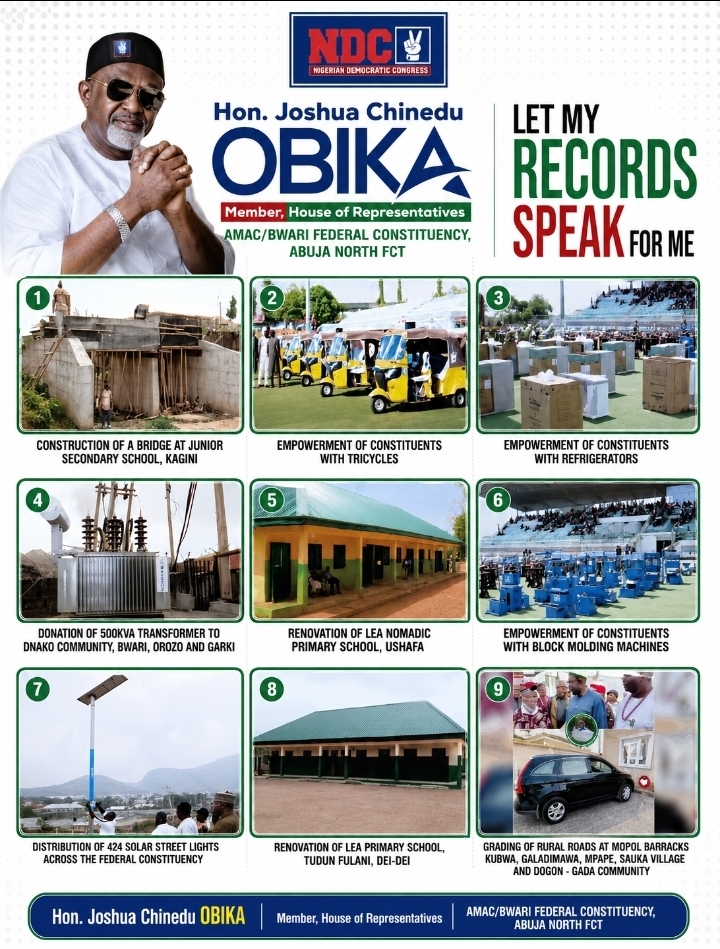
Representation in the National Assembly is often measured by how visible it is at the grassroots. In AMAC/Bwari Federal Constituency of the FCT, Hon. Joshua Chinedu Obika has anchored his tenure on projects and empowerment that residents can see, touch, and use daily. From classrooms to street lights, transformers to tools of trade, the record reflects a constituency-first approach. This perusal by Ekuson Nw’Ogbunka Our Managing Editor in Abuja reviews 9 key interventions and the wider pattern they represent across AMAC/Bwari.
Bridging Access at JSS Kagini
The construction of a bridge at Junior Secondary School, Kagini, addressed a long-standing safety and access challenge. Students and teachers who previously contended with difficult passage during the rainy season now have a safer route to school. For parents, it means fewer missed classes and less risk on the way to learning.
Mobility for Livelihoods: Tricycles
Empowerment with tricycles targeted constituents seeking self-employment in commercial transport. The intervention provided direct income-generating assets, reducing barriers to entry for beneficiaries in both AMAC and Bwari. It is a practical response to unemployment at the community level.
Cold Storage for Small Business: Refrigerators
The distribution of refrigerators supported food vendors, cold drink sellers, and small-scale retailers. By cutting spoilage and extending product shelf life, the intervention helped micro-businesses improve margins and serve customers more reliably across the constituency.
Powering Communities: 500KVA Transformer
A 500KVA transformer was donated to Dnako Community, Bwari, as well as Orozo and Garki areas. Stable electricity is a multiplier for homes, shops, and service points. The transformer was aimed at reducing outages and improving voltage stability in the beneficiary communities.
Learning Environment: LEA Nomadic Primary School, Ushafa
The renovation of LEA Nomadic Primary School, Ushafa, focused on making the school fit for purpose. Repairs and upgrades create a safer, more conducive space for pupils and teachers, especially for a school serving a mobile population that requires flexible learning support.
Tools for Artisans: Block Moulding Machines
Block moulding machines were provided to empower builders and small construction enterprises. The machines lower production costs, speed up delivery, and open more job opportunities for young artisans and apprentices within the constituency.
Safer Nights: 424 Solar Street Lights
The distribution of 424 solar street lights across the federal constituency addressed security and mobility after dark. Solar powering reduces running costs while improving visibility on key roads, markets, and residential clusters in both AMAC and Bwari.
Primary Education: LEA Primary School, Tudun Fulani, Dei-Dei
Renovation work at LEA Primary School, Tudun Fulani, Dei-Dei, targeted classrooms and basic facilities. The aim was to restore learning conditions, improve hygiene, and encourage higher enrolment and retention in a densely populated area.
Connecting Communities: Rural Road Grading
Rural roads were graded at Mopol Barracks Kubwa, Galadimawa, Mpape, Sauka Village, and Dogon-Gada Community. Grading improves access for residents, farmers, and traders, and reduces travel time and vehicle wear on previously difficult stretches.
The Pattern: Infrastructure + Empowerment
Taken together, the interventions show a two-track model: fix public infrastructure and equip people with productive assets. Bridges, schools, roads, and transformers address collective needs. Tricycles, refrigerators, and machines address individual livelihoods.
Geographic Spread Across the Constituency
The projects cut across Bwari and multiple AMAC locations — from Kagini and Ushafa to Dei-Dei, Kubwa, Mpape, Orozo, Garki, Galadimawa, Sauka, and Dogon-Gada. That spread suggests an effort to balance attention across urban and peri-urban communities.
Why These Interventions Matter Locally
Constituents consistently rank access, power, education, and income as top priorities. Each of the listed projects speaks to one or more of those needs. The mix reflects an attempt to align legislative presence with daily realities.
Implementation and Sustainability Considerations
For impact to last, maintenance, community ownership, and follow-up matter. Transformers require load management, solar lights need upkeep, and school renovations require staffing and supplies. The same applies to ensuring empowered beneficiaries can service and sustain their assets.
Conclusion: A Constituency Scorecard in Progress
Obika’s record in AMAC/Bwari reads as a working scorecard: bridges built, schools renovated, lights installed, roads graded, and assets handed to constituents. Whether measured by access, power, or productivity, the projects point to a focus on tangible, community-level results as the tenure continues.