








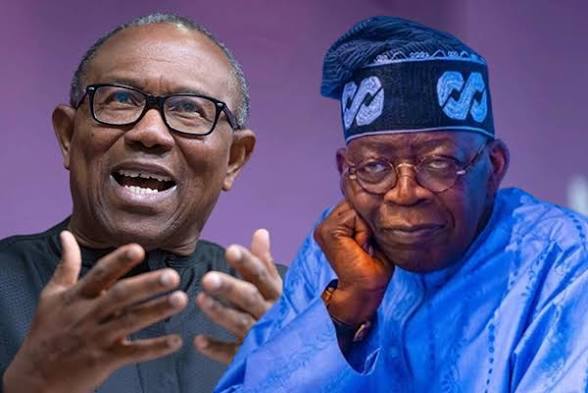
Peter Obi’s demand that President Bola Tinubu resign over governance failures has reignited debate on accountability in Nigeria’s democracy. The former Anambra governor invoked precedent and international examples, while the Presidency dismissed the call as political posturing. A closer look at both positions reveals the tension between constitutional mandates, public expectations, and political strategy, writes Ekuson Nw’Ogbunka, our Managing Editor in Abuja.
Peter Obi, a former Anambra State governor, recalled that before becoming President, Tinubu had repeatedly demanded the resignation of former President Goodluck Jonathan over insecurity and economic challenges facing the country.
Presidential candidate of the Nigeria Democratic Congress, NDC, Peter Obi has called on President Bola Tinubu to resign over what he described as a “monumental failure in governance,” citing worsening economic hardship, insecurity, and declining living conditions across the country.
Obi made the call in a statement posted on his X handle on Monday after reflecting on the resignation announcement by the British Prime Minister, Keir Starmer, which he said underscored the importance of accountability in public office.
According to the former Anambra State governor, the British leader’s decision to step down amid public dissatisfaction with economic conditions and unmet campaign promises offers lessons for countries seeking to strengthen democratic governance.
Drawing parallels with Nigeria’s situation, Obi recalled that before 2015, Tinubu had on several occasions championed the call for then President Goodluck Jonathan to resign over economic hardship and insecurity affecting Nigerians.
Obi specifically referenced the Chibok school kidnapping incident, stating that Tinubu demanded the immediate resignation of President Jonathan, arguing that the government had failed in its most fundamental duty of protecting lives.
He also referenced commitments made by Tinubu during the 2023 presidential campaign, particularly on electricity supply, anti-corruption efforts, and improving citizens’ welfare.
Obi noted that during the 2023 election campaign, Tinubu challenged the electorate not to vote for him for a second term if he failed to deliver on those commitments, especially stable power, fighting corruption, and improving the welfare of Nigerians.
Obi further argued that conditions in the country had deteriorated since Tinubu assumed office, saying critical sectors had witnessed setbacks rather than progress.
He stated that electricity supply remains unreliable, insecurity has intensified in many areas including kidnappings, and economic hardship has deepened rather than eased.
Similar concerns, Obi argued, are reflected across other critical sectors such as security, infrastructure, transportation, and anti-corruption efforts, all of which he said have regressed. “We are in the worst possible condition,” he declared.
The presidential candidate said the situation warranted accountability at the highest level of government and urged the President to step aside.
Obi maintained that such a gesture would help enthrone a political culture rooted in accountability and responsibility, rather than further entrenching impunity.
He added that it would send a powerful message that public office is a sacred trust, not an entitlement, and help build a society in which future leaders understand that failure carries consequences.
Obi concluded that only by ending the culture of impunity can Nigeria secure a better future for the society children will inherit in a New Nigeria that is possible.
He also maintained that embracing accountability and responsibility in leadership remains essential to building stronger institutions and restoring public confidence in governance.
But the Presidency on Monday dismissed the call by Obi for President Tinubu’s resignation, describing it as “childish and hollow” and an attempt to distract from recent electoral victories recorded by the ruling All Progressives Congress.
A statement issued by the President’s Special Adviser on Information and Strategy, Bayo Onanuga, read in part: “Peter Obi’s call for President Tinubu’s resignation is childish and hollow. It is not a call to hold the leader accountable. It is merely a political grandstand.”
The Presidency accused Obi of drawing a false comparison between Nigeria’s presidential system and the United Kingdom’s parliamentary democracy while painting what it described as a distorted picture of the country’s current realities.
According to Onanuga, Obi’s argument ignored the constitutional framework under which Nigeria operates. “We run a presidential system, with the president elected to a fixed four-year term,” he said.
The presidential aide argued that recent election outcomes in Ekiti, Nasarawa, Enugu, Ondo, and Rivers demonstrated public support for Tinubu and the APC, calling the results an early referendum of sorts.
Onanuga defended the administration’s handling of security challenges, insisting that significant gains had been recorded as hundreds of kidnapped victims were rescued and thousands of terrorists neutralised or removed from strongholds.
The Presidency also highlighted economic indicators which it said contradicted Obi’s claim that Nigeria was in its worst condition, citing sustained GDP growth, improved foreign reserves, increased oil production, higher government revenues and stronger investor confidence.
Onanuga further listed strides in infrastructure, education and power sector reforms, including the student loan scheme, major highway projects and the Electricity Act, while acknowledging that inflationary pressures were partly linked to global developments.
He concluded that President Tinubu remains focused on governance and delivering reforms rather than responding to political rhetoric, stating that leadership is about confronting challenges and laying the groundwork for a more prosperous Nigeria.