










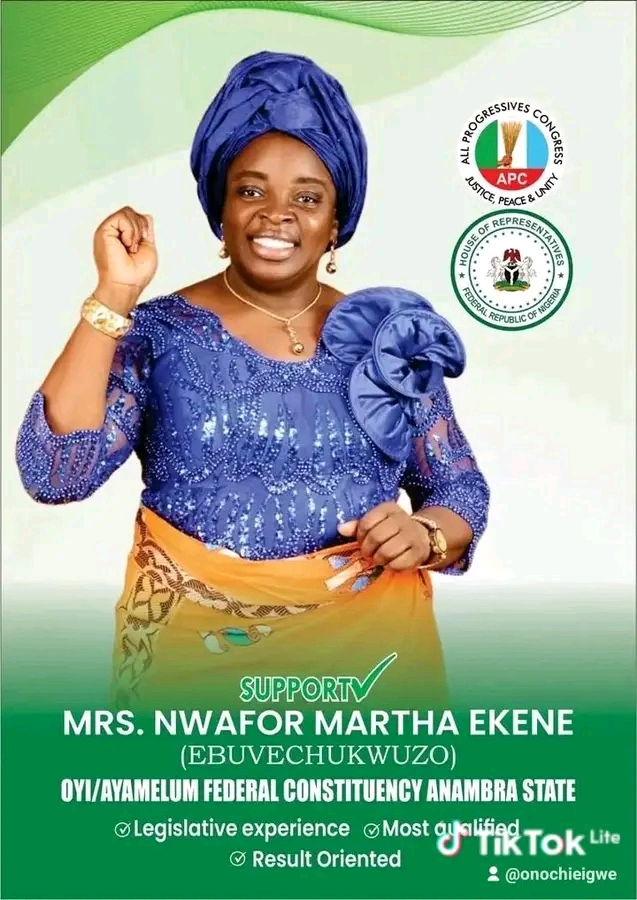
In Oyi/Ayamelum Federal Constituency, Anambra State, the APC candidate Iyom Ekene Martha Nwafor is asking voters to trade campaign rhetoric for résume. Political analyst Abba Onyekachukwu studies her platform, branded Ebuvechukwuzo “Glory Surpasses All” and wonders if 25 years inside the National Assembly will make her different from politicians famous for promises that die after elections. Her agenda leans on experience, agriculture, empowerment and accountability. The question voters will answer in 2027 is simple: has she been living up to her promises, or will this be another cycle of hope deferred? Excerpts.
Iyom Ekene Martha Nwafor is the APC flagbearer for Oyi/Ayamelum, running what she calls an “experience-driven campaign.” The core argument: her over 25 years of hands-on legislative and administrative work at the National Assembly should allow her to hit the ground running on policy and federal access.
That pitch is packaged under Ebuvechukwuzo her campaign identity. She says the name reflects a commitment to leverage civil service and legislative exposure to attract developmental projects immediately, without the learning curve that slows first-term lawmakers.
Experience-Driven Governance is the first pillar. Nwafor plans to use deep knowledge of legislative and budgetary processes to navigate the National Assembly effectively. Her stated goal is to ensure Oyi/Ayamelum is “prepared from day one” to attract government patronage and development.
For constituents from Nteje to Omor, that promise targets a sore point: federal isolation. APC has struggled to secure federal seats in Anambra, and communities often complain of being cut off from Abuja’s resources. Nwafor is betting her networks can change that.
Economic and agricultural advancement is the second agenda item. She is advocating active assistance to farmers in Ayamelum’s hinterlands to tackle produce perishability through stronger distribution chains, business grants, and agricultural support.
Ayamelum is Anambra’s “food basket,” yet post-harvest losses remain a daily reality due to bad roads and weak market linkages. If Nwafor delivers on cold-chain logistics and grant access, rural incomes could shift. If not, she joins a long list of agriculture promises that ended at rallies.
Women and youth empowerment forms the third plank. The campaign emphasizes skill acquisition and capacity development to address youth unemployment, plus targeted programs designed to help women achieve financial independence.
The emphasis is on “capacity, not handouts.” Voters have seen empowerment schemes that stopped at certificate ceremonies. Nwafor’s team says the difference will be mentorship, funding access, and linkage to markets that turn skills into sustainable livelihoods.
Effective representation and accountability completes the four-point platform. She promises transparent, responsible leadership that reconnects Oyi/Ayamelum to the federal center to attract maximum patronage, federal presence, and rapid community development.
On Accountability and Results, Nwafor offers institutional memory built over two decades: policymaking, committee systems, and constituency engagement. Her campaign message is blunt about replacing “recycled politics” with integrity-driven governance.
That anti-recycling stance resonates where incumbents often return with little to show. we note the tension: insider knowledge can open doors in Abuja, but it can also tie a candidate to the same system voters want reformed.
Under grassroots empowerment and infrastructure, the campaign focuses on bringing basic amenities, infrastructure, and human capital development to local communities in both Oyi and Ayamelum LGAs. Exact road projects, she explains, will be mapped through National Assembly zoning and budgetary frameworks after winning.
That qualification is politically realistic. Constituency projects depend on appropriations, executive assent, and committee placement. Nwafor argues experience gives her an edge in that process. Critics say every candidate promises to “influence the budget.”
Her campaign’s strength is preparation. “Prepared from day one” means understanding how bills move, how interventions are inserted, and how oversight can be used to pressure MDAs for constituency projects. In a legislature where seniority matters, 25 years is leverage.
Yet our study circles back to voter skepticism. Experience can mean access, but voters measure it by delivery: kilometers of road, number of farms saved, youths employed, women funded. The CV opens the door; results keep it open.
For now, Ebuvechukwuzo exists on paper and podiums. The verdict belongs to Oyi/Ayamelum electorate. As we conclude, only the ballot and the years after it will reveal if Iyom Ekene Nwafor is different or just another promise waiting for an excuse.