







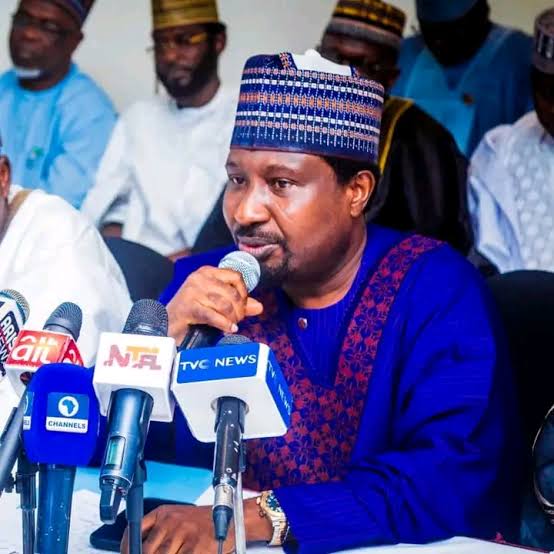
For decades, Nigerians have debated it in town halls, newspapers, and now on live radio. On Saturday, Deputy Senate President Senator Barau I. Jibrin took that debate to the people of the North on Radio Nigeria Kaduna’s “Hannu Da Yawa”. His message was direct: President Bola Ahmed Tinubu’s push for State Police is not a political gimmick. It is, in his words, a “masterstroke” designed to confront banditry, kidnapping, and terrorism where they start, at the community level. As the Senate Committee on Constitution Review considers the bill, the conversation has shifted from if to how, reports Ekuson Nw’Ogbunka, Our Managing Editor in Abuja over the weekend.
Senator Barau, who chaired the two-hour programme, said the proposal had undergone extensive legislative scrutiny. Public hearings were held across the six geopolitical zones and the FCT, gathering views from traditional rulers, security experts, and ordinary citizens.
According to him, the bill did not emerge in isolation. It is an executive bill initiated by President Tinubu after wide consultation with the Presidency, National Assembly, Inspector-General of Police, retired officers, governors, and civil society.
“The President carefully studied the situation,” Barau told listeners. “He discovered that while many Nigerians support State Police, there are fears that it could be abused or misused for political or ethnic purposes. That is why safeguards have been built into the system.”
The core argument is proximity. State Police operatives, Barau explained, will be recruited from local communities. “They know the people, the terrain and even the criminals. This will significantly improve our response to banditry, kidnapping and other crimes.”
For the North, which has borne the brunt of banditry and kidnapping, the Deputy Senate President said the benefits are direct. Responding to Zubairu Mohammed, a farmer from Kankia in Katsina, he said: “The North stands to benefit significantly. This initiative is designed to bring lasting peace to the worst-hit areas.”
Critics have long warned that governors could use State Police as political thugs. Barau addressed that head-on. The bill, he said, contains multiple safeguards and clear legal protections.
“If State Police are used for intimidation or actions that threaten lives and property, the President has the constitutional authority to intervene and direct the Federal Police to take over,” he told Abubakar Auwal of Sokoto.
The architecture is deliberate. The Nigeria Police Force will retain responsibility for national security issues: terrorism, cybercrime, and interstate crimes. State Police will focus on internal law enforcement and public order.
On command structure, Barau said State Police Commandants will be appointed through a rigorous process and protected by law from undue political interference. The goal is professionalism, not patronage.
Funding remains a concern. The Deputy Senate President acknowledged it. He said appropriate financial frameworks and operational standards will be developed as the constitutional amendment and enabling legislation progress.
The bill has already passed the Senate. The next hurdle is the state Houses of Assembly, which must approve the constitutional amendment. Barau expressed confidence they will.
He framed the reform as a response to longstanding public demand. For years, Nigerians have called for constitutional amendments to allow sub-national policing. The Tinubu administration, he said, is listening.
During the programme, callers raised issues beyond policing, banditry in Zamfara, farmer-herder clashes, and youth unemployment. Barau linked them all to weak local security presence.
“State Police will complement, not replace, the Nigeria Police Force,” he stressed. The idea is not duplication but division of labour based on jurisdiction and expertise.
The Deputy Senate President described the process as “balanced and consultative.” No single group dictated the terms. Policing experts, retired officers, and community voices all shaped the draft.
He urged Nigerians to see the reform beyond politics. “We must re-engineer our security architecture to better protect lives and property while guarding against abuse,” he said.
The timing is critical. As insecurity continues to affect farming, education, and investment, the government is betting that local knowledge will outperform centralized control.
Barau’s tone on radio was measured but firm. He answered questions in Hausa, engaging directly with farmers, students, and traders. It was legislation meeting the grassroots.
If passed by state assemblies, Nigeria will enter a new policing era, one where a constable in Kankia or Zaria answers to both state law and federal oversight.
For Senator Barau, the choice is clear: continue with a centralized system that is overstretched, or decentralize with safeguards. “This is a necessary step towards lasting peace and security,” he said. The Senate has voted. Now the states must decide.