










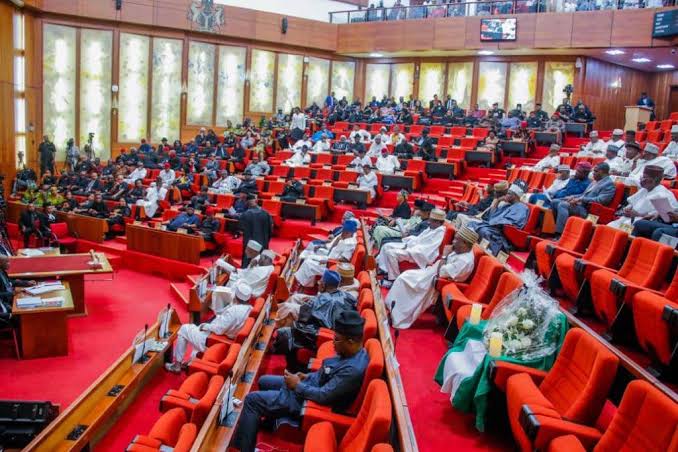
Nigerian courts have for years been clogged with cases that drag on for years, largely because there are too few judges to handle the workload. Determined to fast-track justice delivery, the Senate on Wednesday passed two bills on second reading to increase judicial manpower and modernize court processes. Managing Editor Ekuson Nw’Ogbunka reports excerpts from the legislative push.
The logjam in Nigeria’s courts is no longer just a legal problem, it is a social and economic crisis. Families wait decades for inheritance cases, businesses stall over unresolved contracts, and criminal suspects spend years awaiting trial. The root cause, legal experts say, is simple: insufficient judges.
To address this, the Senate deemed it fit to increase the number of judges across federal courts. The move signals a recognition that justice delayed is justice denied, and that court capacity must match the volume of disputes in a population of over 200 million people.
Two bills scaled second reading during Wednesday’s plenary. The first, SB. 990, is a Bill for an Act to Amend the Federal High Court Act Cap. F12, LFN, 2004, to increase the number of Judges of the Federal High Court and for Related Matters, 2026.
The second, SB. 991, seeks to amend the Court of Appeal Act, Cap. C36, LFN, 2004. It proposes to raise the number of Justices of the Court from seventy to one hundred and ten, and to provide for the integration of virtual court proceedings.
Both bills were sponsored by Senate Leader, Sen. Bamidele Michael Opeyemi of Ekiti Central. He argued that expanding the benches is the most direct way to reduce case backlogs and restore public confidence in the judiciary.
The proposal to add 40 more justices to the Court of Appeal is significant. Currently, 70 justices sit across multiple divisions nationwide. Increasing them to 110 means more panels can sit simultaneously, cutting the time it takes for appeals to be heard.
Equally important is the provision for virtual court proceedings in SB. 991. Advocates say technology can reduce adjournments caused by logistics, insecurity, and transportation challenges, especially for witnesses and lawyers in distant locations.
For the Federal High Court, SB. 990 aims to adjust the judge-to-case ratio that has remained stagnant despite population growth and commercial expansion. More judges would allow divisions to handle civil, criminal, and constitutional matters without months-long waiting lists.
If passed into law, the reforms could shorten trial durations, ease pressure on detention centres holding awaiting-trial inmates, and make Nigeria more attractive for investors who depend on timely contract enforcement.
The bills now head to committee for detailed scrutiny before third reading. For millions of Nigerians whose cases have spent years in court, the Senate’s action offers hope that the era of justice delayed may finally be giving way to justice delivered.