








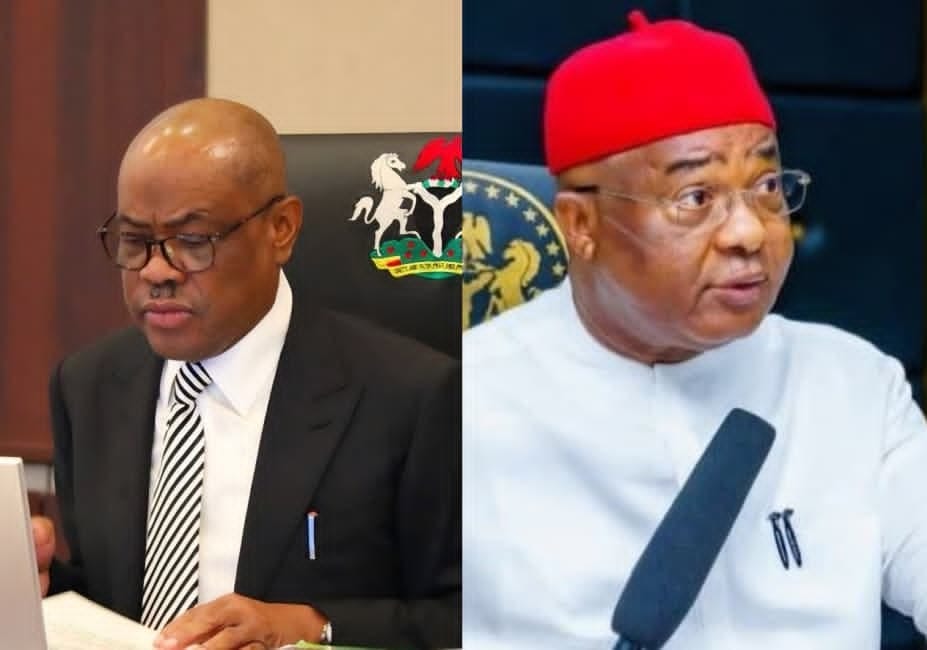
Here Ekuson Nw’Ogbunka Our Managing Editor takes a look at Chukwuemerie Uduchukwu’s article on Imo State Gov Hope Uzodimma and the FCT Minister Nyesom Wike. The widening political disagreement between the governor and the minister has introduced another significant fault line into the preparations for Nigeria’s 2027 general elections. What began largely as a disagreement over political alliances has increasingly become a broader argument about party discipline, presidential support and the freedom of politicians to pursue cross-party arrangements. The consequences could extend beyond the personalities involved, particularly as both men possess established political networks. Read. The excerpts.
On September 15, 2026, Uzodimma, in his capacity as Chairman of the Progressive Governors Forum (PGF), announced that APC governors would not participate in or support political arrangements capable of undermining President Bola Tinubu’s re-election bid, weakening the APC or adversely affecting the party’s candidates. The statement came against the backdrop of Wike’s proposed “Rainbow Coalition”, which has been presented as a platform for mobilising support for Tinubu while allowing participating politicians to retain their respective party identities.
That distinction is important.
Uzodimma’s publicly stated position can be understood as a defence of the APC’s organisational structure and official candidates rather than simply a personal attack on Wike. From the perspective of the APC governors, an arrangement that encourages politicians to support the President while simultaneously backing candidates outside the APC could create competing political interests within the ruling party. That is the central argument contained in their position.
Wike, however, has offered a different interpretation. He has said that his political objective is to support President Tinubu and that he never approached the APC Governors Forum seeking an alliance. He has also maintained that supporting Tinubu does not necessarily require politicians to abandon their parties or cease supporting candidates of their respective parties in other elections.
This is therefore more complicated than a simple Uzodimma-versus-Wike confrontation. At its heart is a disagreement over the meaning of political loyalty ahead of 2027. The APC governors appear to be insisting that presidential support should operate within the party’s formal structure, while Wike’s position is that a broader coalition can support the President without eliminating the separate identities and interests of participating political actors.
The political history of both men also explains why the disagreement has attracted considerable attention. Wike remains an influential political figure following his tenure as governor of Rivers State and his subsequent appointment as FCT Minister. During the 2023 presidential election, Tinubu won Rivers State with 231,591 votes against Peter Obi’s 175,071 votes, according to results reported from the state collation. That result has continued to feature prominently in arguments about Wike’s political influence, although electoral outcomes are produced by voters and cannot simply be attributed to one individual.
For Uzodimma, the issue is equally significant because he is simultaneously governor of Imo State and chairman of the APC governors’ umbrella body. His statements on behalf of the PGF therefore carry a party-wide dimension that goes beyond his personal political interests. The South-East APC leadership has subsequently backed the governors’ position and criticised Wike’s recent remarks, demonstrating that the disagreement is generating wider political reactions.
The argument advanced by Uduchukwu that Uzodimma is fighting an unwinnable “proxy war”, however, remains an interpretation rather than an established political fact. There is evidence of a public disagreement between the two camps, but whether it becomes a damaging political confrontation, a temporary disagreement or eventually gives way to accommodation will depend on developments between now and 2027.
The same caution applies to claims about Uzodimma’s alleged senatorial ambitions and any supposed plan to become Senate President. Those are political calculations attributed to the governor by the article, not established outcomes. The present Senate President, Godswill Akpabio, has publicly backed Tinubu’s 2027 re-election and continues to operate within the administration’s political structure. But that alone does not establish that Uzodimma intends to challenge him or that the Presidency would oppose such an ambition.
There is, nevertheless, a broader political lesson in the dispute. In an election cycle involving numerous parties, alliances and individual political interests, the ruling party faces the challenge of maintaining internal discipline while accommodating politicians whose political histories extend beyond its formal structures. Wike’s case illustrates that complexity particularly clearly: he is a PDP figure serving in an APC-led federal administration while openly declaring support for Tinubu. His “Rainbow Coalition” proposal consequently sits at the intersection of party politics and broader presidential mobilisation.
For Uzodimma, meanwhile, the practical political challenge is to balance his responsibilities as Imo governor, PGF chairman and a key APC figure in the South-East. His supporters can argue that defending the APC’s candidates and structures is part of his responsibility as forum chairman. Critics can equally argue that prolonged confrontation with influential political actors could consume political energy that might otherwise be directed towards governance and party mobilisation.
The same scrutiny applies to Wike. His political influence may give him room to operate across traditional party boundaries, but his approach also risks creating friction with APC structures that are determined to protect their candidates and organisational interests. The fact that the PGF has publicly rejected the proposed coalition demonstrates that not all actors within the ruling party are prepared to accommodate his strategy.
Ultimately, the emerging Uzodimma-Wike confrontation should not be reduced to a contest over who is politically stronger. It is a test of competing strategies for securing influence ahead of 2027: one built around party discipline and formal structures, and another centred on a broader coalition capable of cutting across party lines.
The most consequential question is therefore not whether Uzodimma can defeat Wike, or vice versa. It is whether the APC and its allies can manage these competing interests without allowing internal disagreements to undermine their respective political objectives. With the 2027 elections still ahead, there remains considerable room for negotiation, realignment and political accommodation.
What appears today as confrontation could ultimately become another episode in Nigeria’s long tradition of pre-election bargaining. But if the disagreement continues to deepen, both the APC’s internal cohesion and the wider coalition supporting Tinubu’s re-election will face a more complicated political environment. The coming months will reveal whether the Uzodimma-Wike dispute becomes a temporary political storm—or a defining fault line in the road to 2027.