




The Senate Committee on South East Development Commission has ordered the Managing Director of SEDC, Mark Okoye, and his management team to give a full account of N16.6 billion released to the Commission from the 2025 budget. Our Managing Editor, Ekuson Nw’Ogbunka, was at the investigative hearing and brings you the excerpts as lawmakers probe questionable expenses, including N153 million for a one-room liaison office.
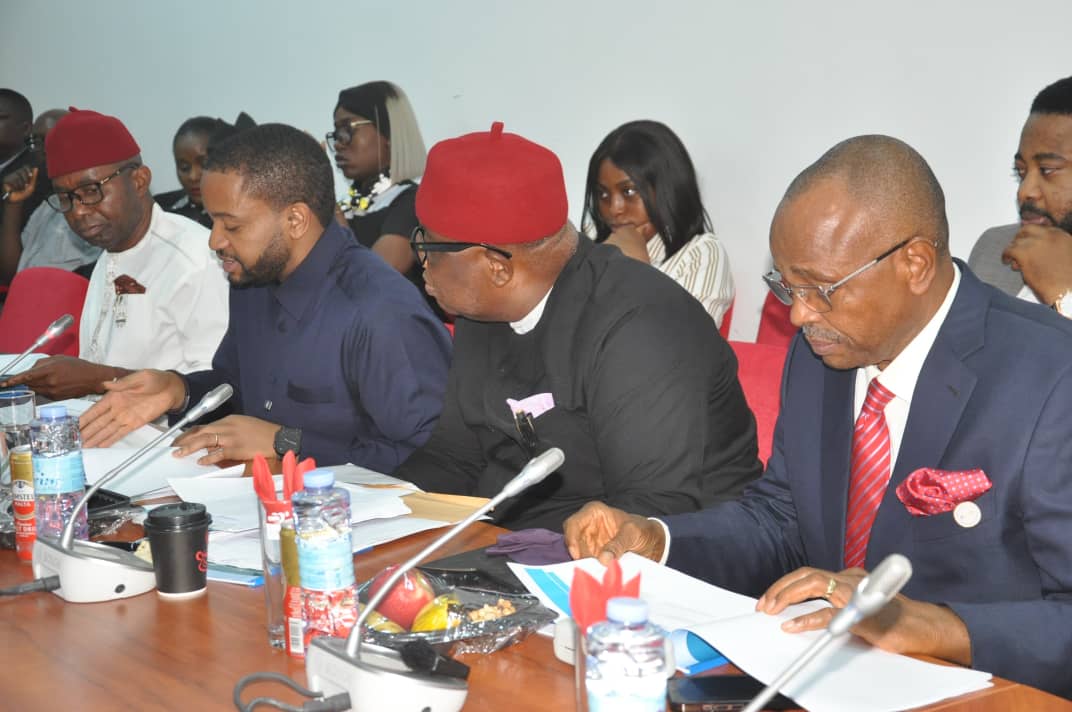
The Senate on Tuesday, through its Committee on South East Development Commission, SEDC, confronted the Managing Director of the Commission, Mark Okoye, over suspected mismanagement of N16.6 billion received from 2025 budget allocations.
The committee, chaired by Senator Orji Uzor Kalu, Abia North, zeroed in on two items that raised eyebrows: N153 million the commission claimed it spent to rent a single-room liaison office in Abuja and N2.5 billion listed vaguely as “implied expenditure”.
Tension rose as the MD and other top management staff struggled to defend the financial report submitted during the investigative hearing. Lawmakers said the document lacked the detail needed for proper oversight.
Irked by the MD’s failure to account for expenditures made so far from the N16.6 billion federal release, members of the committee and the chairman expressed disappointment and vowed to compel full accountability.
Senator Orji Uzor Kalu revealed that an inquiry to the Central Bank of Nigeria showed N13 billion was still left from the N16.6 billion SEDC collected in December last year. That left N3.6 billion spent and unaccounted for.
“This committee is disappointed with the financial report given, which is completely unacceptable,” Kalu declared, stressing that the Senate would not allow public funds to be spent without proper documentation.
Other committee members, including Senator Enyinnaya Abaribe, Abia South; Victor Umeh, Anambra Central; and Austin Akobundu, Abia Central, voiced displeasure over the vague report and demanded receipts, contracts, and payment vouchers.
In his defence, the SEDC MD insisted that expenditures carried out so far were judicious and guided by the Commission’s mandate to deliver priority projects across the South East.
“Our approach has been to ensure that available resources are directed towards priority projects. We want allocations to guide the procurement process so that contracts awarded can be backed by available funding,” Okoye told the lawmakers.
He said the Commission was determined to avoid the cycle of abandoned projects caused by awarding contracts without cash backing. “What we want to avoid is a situation where contracts are awarded without the financial capacity to execute them,” he explained.
Okoye used the Commission’s N140 billion budget envelope as an example: “Having a budget of N140 billion does not automatically mean that N140 billion in cash is available. It would be irresponsible to award contracts worth the entire budget if only N10 billion or N20 billion has actually been released.”
He warned that such practice would create unfunded liabilities and a significant financial deficit. According to him, SEDC was pacing its commitments to match actual releases from the federal government.
The explanation, however, failed to satisfy the committee. Lawmakers argued that even funds released must be traceable to specific projects, beneficiaries, and procurement processes.
Consequently, the Chairman directed the commission to submit comprehensive records, including contract details, payment information, and all supporting documents, latest by the 23rd of this month.
“By the 23rd, we want to have the complete documentation. Once we receive and review the documents, we will determine the date for your next appearance before the committee,” Kalu said, setting a clear deadline.
The Chairman then adjourned the session, reiterating the committee’s expectation that all requested information would be submitted within the stipulated timeframe. For SEDC, the next few days will determine whether it can convince the Senate that N3.6 billion was spent in the interest of South East development, or whether it faces deeper sanctions for fiscal opacity.