

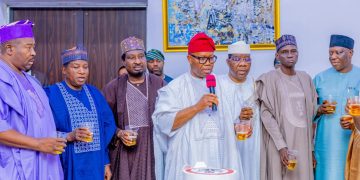









The reported acceptance of 2027 presidential campaign coordination roles by opposition leaders has sparked debate over the future of Nigeria’s multiparty democracy. Amobi Nzelu Esq., a private legal practitioner and principal partner at Chinenye Chambers, has questioned the democratic implications of the move, raising concerns about opposition independence, political alliances and the preservation of meaningful electoral competition, Ekuson Nw’Ogbunka, Our Managing Editor writes from Abuja.
Nzelu, who was called to the Nigerian Bar in 1980 and became widely known for his involvement in the Apo Six case, views the reported appointments as part of a wider political strategy whose implications extend beyond individual politicians. In his assessment, the development raises questions about the strength of opposition parties, the independence of political actors and the ability of competing political platforms to sustain meaningful democratic alternatives.
The acceptance of campaign appointments by politicians associated with opposition parties is not, by itself, sufficient to establish that Nigeria is abandoning multiparty democracy. Political actors may cooperate across party lines for strategic, ideological, personal or negotiated reasons. The more important question is whether such cooperation strengthens democratic participation or gradually weakens the capacity of opposition parties to offer credible alternatives to the electorate.
Nzelu’s remarks suggest that political agreements may have influenced some of the decisions being discussed. Referring to the argument that agreements must be respected, he questioned whether the public knows the full circumstances surrounding political alliances and appointments. However, without independently established details of the arrangements involved, it would be inappropriate to assume that every appointment resulted from a particular bargain or that any agreement necessarily undermines democratic principles.
The principle of freedom of political association is central to democratic governance. Politicians, like other citizens, have the right to support candidates, cooperate with political movements and reconsider their affiliations within the law. Consequently, accepting a campaign role should not automatically be treated as evidence of disloyalty or misconduct. Nevertheless, political freedom also carries a responsibility to explain major decisions to supporters who expect consistency between a politician’s stated beliefs and subsequent actions.
A central concern raised by Nzelu is the possibility that extensive cross-party recruitment could weaken the distinction between the ruling party and its opponents. In a healthy democracy, the opposition is expected to scrutinise government policies, expose shortcomings, propose alternatives and provide voters with meaningful choices. If leading opposition figures increasingly align themselves with the incumbent’s re-election project, the public may reasonably question whether the remaining opposition structures can perform these functions effectively.
However, the existence of political alliances does not automatically mean that the opposition has disappeared. Democratic systems can accommodate coalitions, defections and cooperation between politicians who previously disagreed. Opposition parties can also rebuild their structures, recruit new leaders and develop alternative policy programmes. Whether the current political developments represent normal competition or a more serious weakening of opposition politics will depend on the durability of these alliances and their practical consequences.
Nzelu described Tinubu as an experienced political strategist who understands how to build relationships across political and regional boundaries. This observation points to a significant feature of Nigerian politics: successful candidates often cultivate networks that extend beyond their immediate party organisations. Such outreach can broaden participation and encourage cooperation, although its democratic value depends on whether alliances are based on transparent political objectives and public-interest commitments rather than arrangements that voters cannot adequately evaluate.
The lawyer also questioned the wider political environment in which these realignments are taking place, arguing that Nigeria’s democratic difficulties predate the present administration. This is an important qualification. Problems involving political patronage, institutional accountability, party organisation and the concentration of influence cannot be assessed fairly by attributing every weakness to one government. A balanced examination must consider the contributions of successive administrations, the conduct of political parties and the effectiveness of institutions responsible for protecting democratic competition.
His position also invites a distinction between the legality of political appointments and their political consequences. An appointment to coordinate a presidential campaign is not inherently evidence of wrongdoing. Yet a development may be lawful while still attracting legitimate public scrutiny over its implications for party identity, ideological consistency and the independence of political leaders. Democratic accountability requires room for both legal assessment and informed public debate.
Beyond the political calculations surrounding 2027, Nzelu devoted considerable attention to the economic pressures facing ordinary Nigerians. He cited high living costs, fuel-related expenses, food insecurity and the difficulties confronting families trying to meet basic needs. His argument was that political strategy should not overshadow the urgent responsibility of government to improve living conditions. These concerns place the debate over campaign alliances within a broader question of whether political competition translates into measurable public benefit.
The lawyer’s comments about social hardship were particularly forceful, as he described circumstances in which economic distress can undermine family stability and expose vulnerable people to desperate choices. Such observations should be understood as his assessment of the country’s social conditions rather than as independently verified measurements of national trends. Nonetheless, the underlying issues of affordability, employment, access to essential services and household welfare deserve serious attention from policymakers and political organisations across party lines.
Nzelu also called for greater attention to corruption and accountability, urging the president to give governance a more humane focus. His remarks reflect a wider expectation that political leaders should be judged not only by their ability to win elections or expand their coalitions but also by their handling of public resources and their responsiveness to citizens. Stronger transparency, effective oversight and credible public reporting would help voters evaluate the performance of the administration and the promises of its challengers.
His reference to the democratic ideals associated with former President Goodluck Jonathan further illustrates the importance of institutional continuity and electoral confidence in Nigerian politics. However, the performance of any administration should be assessed against verifiable records, policies and outcomes rather than political nostalgia or individual praise. Nigeria’s democratic future depends on institutions that can withstand pressure, parties that can organise independently, and citizens who can freely compare competing visions for the country.
Ultimately, Nzelu’s interview presents a warning about the possible consequences of extensive political realignment without establishing that Nigeria has already become a one-party state. The acceptance of campaign appointments by opposition-associated politicians raises legitimate questions about political independence, but the answers must come from evidence, transparent explanations and the conduct of all parties involved. As the 2027 election approaches, the most important test will be whether Nigeria preserves meaningful electoral choice while addressing economic hardship, strengthening public accountability and ensuring that political competition remains focused on the welfare of citizens.