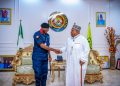

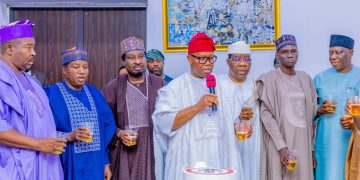





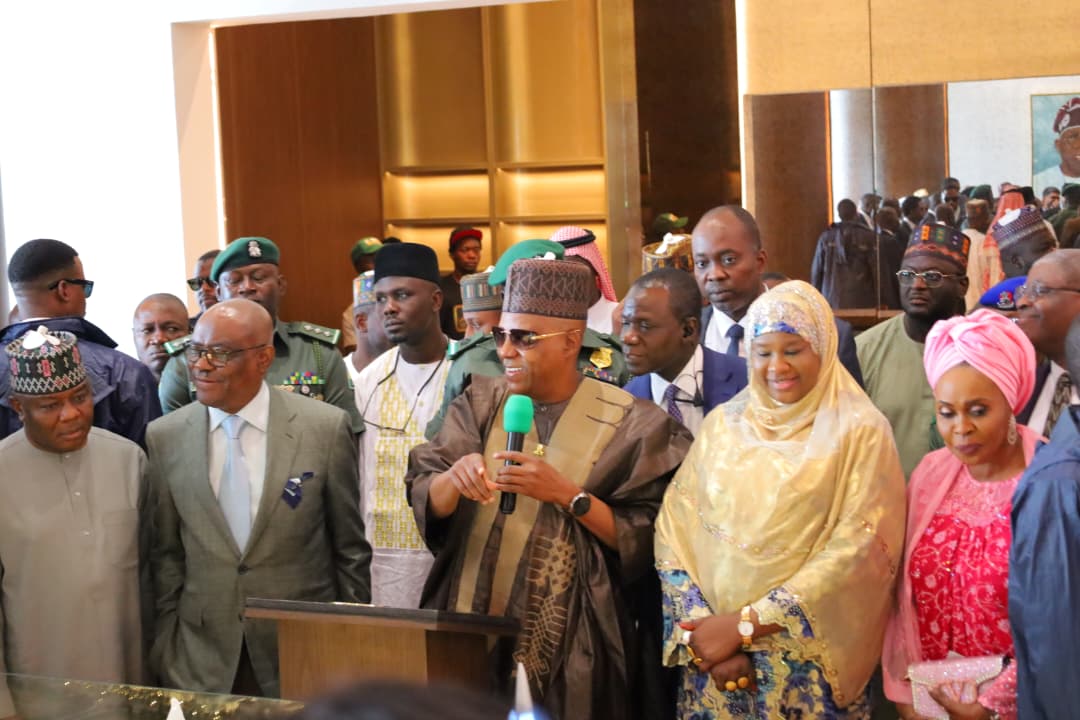
Here, Ekuson Nw’Ogbunka Our Managing Editor writes that in Thursday, recently, the Airport Road corridor in Abuja came alive with a promise that has been dormant for three decades. President Bola Ahmed Tinubu, represented by Vice President Kashim Shettima, officially launched the Abuja City Walk Development project with the inauguration of its Experience Centre — a multi-billion-dollar undertaking that the administration says will turn the Federal Capital Territory into a global hub for commerce, tourism, and luxury living. Framed as a flagship of the Renewed Hope Agenda, the project is being sold not just as buildings and boulevards, but as an economic engine for a young, fast-growing nation.
The ceremony drew a heavyweight crowd: government officials, foreign diplomats, captains of industry, and development partners. The location itself tells the story. Situated within the Abuja Technology Village, ATV, corridor, the site had for years been claimed by speculators and land grabbers. Today, it is being rebranded as the gateway to a new Abuja.
President Tinubu called the project one of the most ambitious private-sector collaborations in Nigeria’s history. “Today, we are not just opening a building; we are unveiling the window to a multi-billion-dollar future,” he declared. “On assumption of office, we promised Nigerians a radical economic transformation and infrastructure renewal. This Experience Centre stands as proof that our administration does not just make promises: we execute them with determination.”
The model is deliberate. Patterned after Dubai City Walk, Abuja City Walk is envisioned as an open-air, walkable district where culture, innovation, commerce, and daily life converge. But officials insist it will be bigger, more dynamic, and rooted in Nigeria’s sociocultural context.
To make that vision investible, the President announced Free Trade Zone status for the corridor. The designation is meant to eliminate trade friction and create fertile ground for regional commerce, medical tourism, premium retail, and high-end hospitality. It is a direct signal to both domestic and foreign investors.
“Let me use this medium to reassure both domestic and international investors — Nigeria is open for business, and your investments are safe,” Tinubu said. The statement reflects the administration’s broader push to position Nigeria as a destination for large-scale, bankable infrastructure.
The economic logic goes beyond aesthetics. With Nigeria’s average population age at 17.9 years and projections of 440 million people by 2050, the President argued that mega projects are essential to channel youth energy productively. Abuja City Walk is pitched as part of that answer.
According to projections shared at the launch, the development will generate tens of thousands of direct and indirect jobs. The impact is expected to ripple through localized supply chains — from cement manufacturing to advanced digital tech services.
The scale is massive. The CityWalk will sit on 250 hectares and is described by developers as “a living ravine.” The master plan includes a boulevard, a technology hub dubbed the ‘Abuja Silicon Valley’ with two universities, offices, and a cultural hub with museums and libraries.
It also envisions a multipurpose indoor arena with cinemas and gyms, CityWalk malls, a fashion avenue, five-star hotels, and an iconic 450-meter skyscraper — which developers say will be unlike any in Africa. Health infrastructure is not left out: diagnostic centers, clinics, hospitals, pharmacies, and medical research centers are all penciled in.
Security and utilities have been factored into the design. The plan includes a police station, fire station, ambulance stations, a utilities hub, mosques, and churches. Green corridors and iconic public spaces are central to the idea of climate-responsive urbanism.
Behind the scenes, the project’s momentum is being credited to aggressive administrative reforms. FCT Minister, Barrister Nyesom Wike, said the ATV corridor had lain fallow for over 30 years before his administration reclaimed it and cleared bureaucratic hurdles.
Wike disclosed that a fast-tracked development committee was set up to oversee execution. In what he called an unprecedented move, building approvals that usually take months were finalized in 48 hours. Access roads were also constructed rapidly by CGC Nigeria Limited to prepare the site.
But the Minister struck a firm tone on accountability. Addressing development partners MAG International Links and Link Developments, he warned that land allocation is tied strictly to performance. “If that is not achieved, we will take back our land. Because I’m not interested in theory. I’m interested in keeping to our agreements,” he said.
That stance reflects a broader shift in FCT land administration — from speculation to execution. Wike also commended the Acting Executive Secretary, Engr. Richard Yunana Dauda, for consistent support in driving the project forward.
Project developers gave more detail on the vision. Dr. Kassim Gidado, Executive Director of Detric Links Development, said the master plan reflects “careful planning, thoughtful engagement, and an unwavering commitment to delivering lasting value.” The goal, he said, is “a city within a city.”
Peter Young, CEO of Broadgate Development Group and representative of the project partners, expressed confidence that Abuja City Walk will set a new African benchmark for integrated master planning, sustainability, and structural design. He said it will ultimately make Abuja “an irresistible destination for multinational corporations and global institutional investors.”
The political framing is clear. For the Tinubu administration, Abuja City Walk is presented as tangible proof of the Renewed Hope Agenda — infrastructure renewal married to economic expansion. For the FCT, it is an attempt to reclaim lost potential and reposition the capital for the next 30 years.
Whether that promise materializes will depend on execution, financing, and public trust. The Experience Centre is open. The master plan is launched. The timelines are set. Now, the work of turning a ravine on Airport Road into a walkable, investible, and livable “city within a city” begins.