









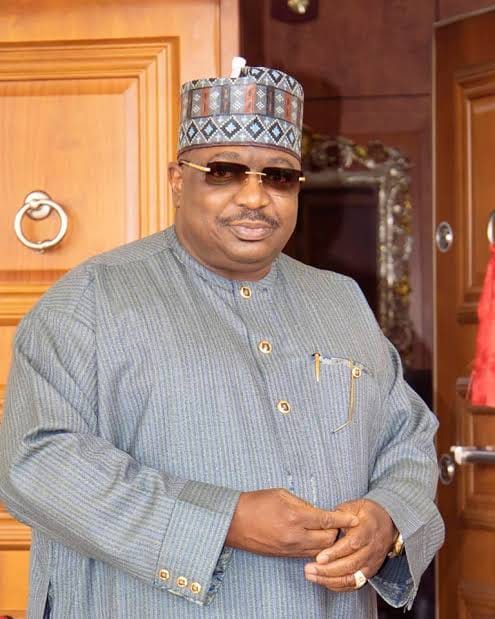
From Karu councillorship to House of Representatives, three Senate terms and Minority Leadership, Philip Tanimu Aduda’s political journey has been deeply intertwined with Abuja. Now, with the 2027 election approaching, the veteran politician is back in the race, and this time on the platform of the APC.
By Aba O. Abba, Managing Editor, News Maker in Abuja
For Senator Philip Tanimu Aduda, Abuja is not simply a constituency; it is the political environment in which he built his career. From the grassroots of Karu to the National Assembly, Aduda has spent decades navigating the politics, communities and institutions of the Federal Capital Territory. His return to the 2027 FCT senatorial race therefore carries the weight of history: a politician who represented the territory in the Senate for 12 years is seeking to reclaim the seat he lost in 2023. The question is whether the experience that once made him one of Abuja’s most influential political figures can once again translate into electoral victory.
The Journey from Karu
Aduda’s political journey dates back to 1996, when he was elected councillor representing Karu Ward. His early involvement in grassroots politics gave him first-hand exposure to the concerns of ordinary residents and the administrative realities of the FCT. He subsequently moved into national politics, winning election to the House of Representatives in 2003 to represent the AMAC/Bwari Federal Constituency. He was re-elected in 2008, serving two terms in the Green Chamber.
His time in the House was significant because he was appointed Chairman of the House Committee on the Federal Capital Territory. The position placed him at the centre of parliamentary oversight of Abuja at a time when the capital was expanding rapidly. In 2009, he was also recognised with a Best Performing Legislator award for his contribution to constituency development.
Twelve Years in the Senate
In 2011, Aduda moved from the Green Chamber to the Red Chamber, winning the FCT senatorial election. He retained the seat in 2015 and again in 2019, giving him three consecutive terms and 12 years of representation in the Senate, from 2011 to 2023. His Senate career also saw him rise beyond ordinary membership into the leadership structure of the chamber.
His Senate leadership record is particularly noteworthy. He served as Chairman of the Senate Committee on Power and later became Senate Minority Whip. In June 2022, he assumed the position of Senate Minority Leader, placing him among the principal political figures in the National Assembly. For supporters, that progression demonstrates not only electoral endurance but also an ability to operate within the complex power structure of Nigeria’s federal legislature.
The Aduda Record
Aduda’s supporters have consistently presented his years in the National Assembly as a period of substantial constituency intervention. His political profile has been associated with projects in infrastructure, education, healthcare, empowerment and community development across the FCT. In 2023, shortly before leaving the Senate, he showcased road projects valued at about N2.8 billion which he said he had facilitated across wards in Bwari and AMAC.
His current campaign platform also presents a much wider catalogue of interventions, claiming more than 140 infrastructure-development projects, over 160 community engagements, more than 1,000 constituency projects and over 50 policy-advocacy initiatives during his years of public service. Those figures are campaign claims and should be understood in that context, but they nevertheless illustrate the central argument of the Aduda campaign: that his political career has been built around a sustained presence in FCT communities rather than occasional electoral-season appearances.
A Politician Who Knows the Six Area Councils
Another important element of Aduda’s political appeal is the breadth of his experience across the territory. The FCT senatorial district covers Abuja Municipal, Abaji, Bwari, Gwagwalada, Kuje and Kwali. His political career, spanning grassroots representation, the House and Senate, has therefore given him exposure to both the urban Abuja constituency and the satellite towns and rural communities that make up the wider FCT. In a territory where questions of land, infrastructure, transportation, healthcare, education, security and representation remain politically sensitive, that institutional familiarity could prove valuable.
The 2023 Setback and the Comeback
Yet Aduda’s political story is not one of uninterrupted victories. His 12-year Senate tenure ended after the 2023 election, when he lost the FCT seat to Ireti Kingibe. His return, therefore, is also a political comeback. It raises a fundamental question for the electorate: have the years away from the Senate diminished his political influence, or have they strengthened his determination to return and complete what his supporters regard as unfinished business?
The political landscape has also changed. In March 2026, Aduda left the Peoples Democratic Party and joined the All Progressives Congress, promising to work for the ruling party’s victory. In May 2026, he emerged unopposed as the APC’s candidate for the 2027 FCT senatorial election. The move represents perhaps the most consequential political realignment of his career and gives the veteran politician a new platform from which to attempt his return to the Senate.
The Political Question of 2027
But experience alone will not decide the election. Abuja’s electorate is changing, its population is growing, and expectations of representation are increasingly centred on tangible development, effective advocacy and accessibility. Voters will want to know not only what a candidate did in the past, but what he intends to do differently in the future. For Aduda, this makes the 2027 contest both an election and a test of political memory: can a record built over more than two decades persuade voters to reopen a chapter they closed in 2023?
His greatest strength may be the depth of his institutional experience. Few contenders can match a trajectory that stretches from councillorship to the House of Representatives, three Senate terms and the position of Senate Minority Leader. He understands the legislative process, knows the workings of the National Assembly and has built relationships within Nigeria’s political establishment over many years. His supporters argue that such experience could translate into stronger lobbying power for FCT projects and greater influence in Abuja’s national political arena.
Ultimately, the 2027 FCT Senate election will put Aduda’s political legacy under a fresh microscope. His supporters will campaign on experience, accessibility, constituency development and a record of service; his opponents will inevitably challenge voters to judge that record against the new realities of Abuja. But one fact is difficult to ignore: Philip Tanimu Aduda is not entering the race as a political newcomer. He is returning with a history, a network and a record built across three decades. Whether that history becomes his greatest political asset—or whether the electorate decides it is time for a new chapter, will be determined by the voters of the Federal Capital Territory in 2027.
POLITICAL JOURNEY AT A GLANCE
1996: Elected Councillor, Karu Ward.
2003–2011: Member, House of Representatives, AMAC/Bwari Federal Constituency.
House of Representatives: Chairman, House Committee on the FCT.
2009: Recognised with a Best Performing Legislator award.
2011–2023: Senator representing the FCT for three consecutive terms.
Senate: Chairman, Committee on Power; later Senate Minority Whip.
2022: Became Senate Minority Leader.
2023: Lost the FCT Senate seat to Ireti Kingibe.
March 2026: Defected from PDP to APC. May 2026: Emerged APC’s FCT senatorial candidate for 2027.
National honour: Commander of the Order of the Niger.