










Addressing issues of motor vehicle, traffic safety administration in Nigeria.
By Paschal Emeka
Accident Prevention and Rescue Initiative (APRI), a leading Non Governmental Organization (NGO) in road safety advocacy and activism, is marking its 20th year anniversary.
In this interview with select journalists, the Executive Director APRI, Amb. Fidelis Nnadi bared his mind on the journey so far, and the vision and mission of the road safety focused NGO. Excerpts:
What are the aims and objectives of the founding fathers of APRI?
Accident Prevention and Rescue Initiative came into existence in September 2006 as a Non Governmental Organization dedicated to road safety education, complimenting emergency response for road crash victims, road safety policy advocacy, and the promotion of best practices in Motor Vehicle Administration across Nigeria.
The aims and objectives of the organization are to ensure safer roads through structured Motor Vehicle Administration and effective road traffic management in Nigeria.
Acknowledging that safer roads, structured Motor Vehicle Administration with effective road traffic management in Nigeria cannot be possible with partnerships and collaborations with government agencies and stakeholders.
Can you let Nigerians know your collaborative efforts within the twenty years of the organization’s existence?
Since the establishment of APRI it has positioned itself as a key partner to government and stakeholders in the efforts towards reducing road crashes, promoting traffic safety rules compliance and professionalizing road transport and traffic enforcement operations within the States and FCT.
What are the pioneering milestones and key events APRI had achieved within the two decades of it’s existence?
APRI has made history as the first road safety-focussed NGO in Nigeria to have organized international and National conferences on Motor Vehicle Administration that exposed the untapped safety and revenue benefits in Motor Vehicle Administration.
Among such conferences is the landmark three days International Conference which was held from 1st to 3rd July, 2010 at Shehu Musa Yar’Adua Center, Abuja.
That conference was partnered with DRTS-FCT and co-sponsored by the Federal Capital Territory Administration (FCTA).
The conference brought together States’ Transport Commissioners, Federal Road Safety Corps, (FRSC), VIOs, Transport Union leaders and International experts to chart a new course and adoption of items of Motor Vehicle Administration in the country as implemented in USA and other developed countries. APRI had equally conducted capacity building for the VIOs in some States.
In the interest of collaborative efforts to improve civil society in the Road Safety sector, APRI joined in the formation and establishment of Coalition of Road Safety NGOs in Nigeria and a leading member of the Coalition.
How has APRI bridged the gap between policy and implementation in road safety and Motor Vehicle administration in the country?
In recognition of our technical and administrative capacity, with grassroots reach, APRI became the first road safety focused NGO to be appointed as Consultants in the implementation of the Special Trade License Regulation in key States which enabled our success in bridging the gap between policy and implementation at grassroot level.
Because it is among road traffic safety regulations the Special Trade License Regulation, is designed to formalise the infomal sector, particularly the operators and service providers in Motor Vehicle Related activities. It compliments security and safety efforts in the road transport sector enabling the profiling and revenue generation from the Motor Vehicle activity sector.
The Special Trade License mandates every person or entities engaged in Motor Vehicle Related activities with aims at formalising this informal sector that are strategic in roadworthiness of vehicles for safety of vehicle occupants.
The Special Trade License implementation is currently enforced in many States including the Federal Capital Territory (FCT), Abuja which was the pilot Territory.
Through this role, APRI led stakeholder engagement, sensitization in the training of enforcement officers and monitoring of compliance to ensure that the regulation achieves it’s objectives of safety and security in the Motor Vehicle Related Trade and Services towards reduced road accidents and road worthiness of vehicles.
Can you explain APRI’s impact and commitment to safer roads?
Speaking of impact, from 2006 when it was incorporated, its work goes beyond advocacy to include direct participation in recommending policy implementation, effective public enlightenment, complimenting road traffic victims rescue operations, and capacity building for road transport unions and officers of government road traffic/VIO agencies.
Our goal is simple: to compliment efforts of government agencies such as FRSC and VIOs in saving road users lives, reduce road crashes, and ensure that Nigeria’s road transport and traffic system is safe, organized and dignified. From the 2010 International Conference, to our current Consultancy roles, we remain committed to partnering with government at all levels to achieve the vision of zero crashes on Nigerian roads.
APRI will continue to call on all motor vehicle dealers, riders and transport operators, including all that are involved in Motor Vehicle Related activities to key into the policy of government on safety and security initiative in the sector.
Accordingly we are stressing that compliance is not punishment, rather protection for lives and property.
Can you recall APRI’s activities in Abia State and the Federal Capital Territory?
APRI was very active in Abia State on road traffic safety advocacy, conducting road traffic congestion in Umuahia and Aba, engaging in daily traffic control and complimenting road safety efforts with the then Administration in the Ministry of Transport responsible for best practice in Motor Vehicle Administration implementation and enforcement in the State, even though the then State Administration did not consider to officially engage our professional recommendations to be part of the activities in the State.
APRI was established in Abia State, standing high with the government Ministry of Transport, Abia State, FRSC and transport unions to carry out public enlightenment campaigns for tricycle drivers, motorcycle riders, and motor vehicle drivers and dealers, on traffic rules, accident prevention, and the dangers of rickety vehicles.
In the area of driving effective Motor Vehicle Administration Reforms, APRI recommended for the adoption and deployment of technology in the implementation of Vehicle Inspection towards improving the certification of roadworthiness for vehicles which has currently been adopted and being implemented Nationwide.
This advocacy is for the States and FCT to further commence implementation of structured Motor Vehicle Administration, urging for synergy with government and the private sector towards achieving objectives in the sector. Considering our partnerships with States in driving the Special Trade License Regulation, we have achieved and are still making positive impact in the many States that we are engaged in.
This included sensitizing motor dealers on documentation, security profiling, and compliance to reduce “one chance” armed robbers and vehicle theft.
APRI conducted series of road safety rallies and first aid training for commercial drivers and riders in major parks, particularly in FCT and Abia State, emphasizing on defensive driving and emergency response.
In addition to many advocacy expert and professional presentations at different conferences, APRI made presentations to the Abia State Ministry of Transport on harmonizing union levies and eliminating multiple taxation, while laying emphasis on proper rider/driver licensing to prevent fake licenses.
In FCT, apart from hosting the first of its kind three day international conference, in 2010, APRI was appointed Consultants for the implementation of Special Trade License Regulation in FCT.
Our roles included stakeholder engagement with motor dealers in Apo, Katampe, Kubwa, stakeholder validation meetings, and training enforcement taskforce to profile traders and curb illegal vehicle trade.
APRI also joined other stakeholders in conducting highway patrols, road crash rescue operations, and public sensitization during ember months along Abuja – Kefffi, Abuja – Lokoja, and within the city routes.
To deepen our road safety campaigns, APRI partnered and will continue to partner with the Federal Road Safety Corps on “Safe to School” and “Don’t Drink and Drive” among other road safety campaigns.
Consistently, APRI had led various road safety and traffic management policy and advocacy against the menace of one chance and improved road traffic patrols and enforcement in FCT.
APRI had at various times recommended best practices for dispatch riders and other road users within the road transport unions towards engagements with the Federal Capital Territory Administration (FCTA) to address the consistent lapses in road traffic management in FCT and many other Ministry of Transport of States.
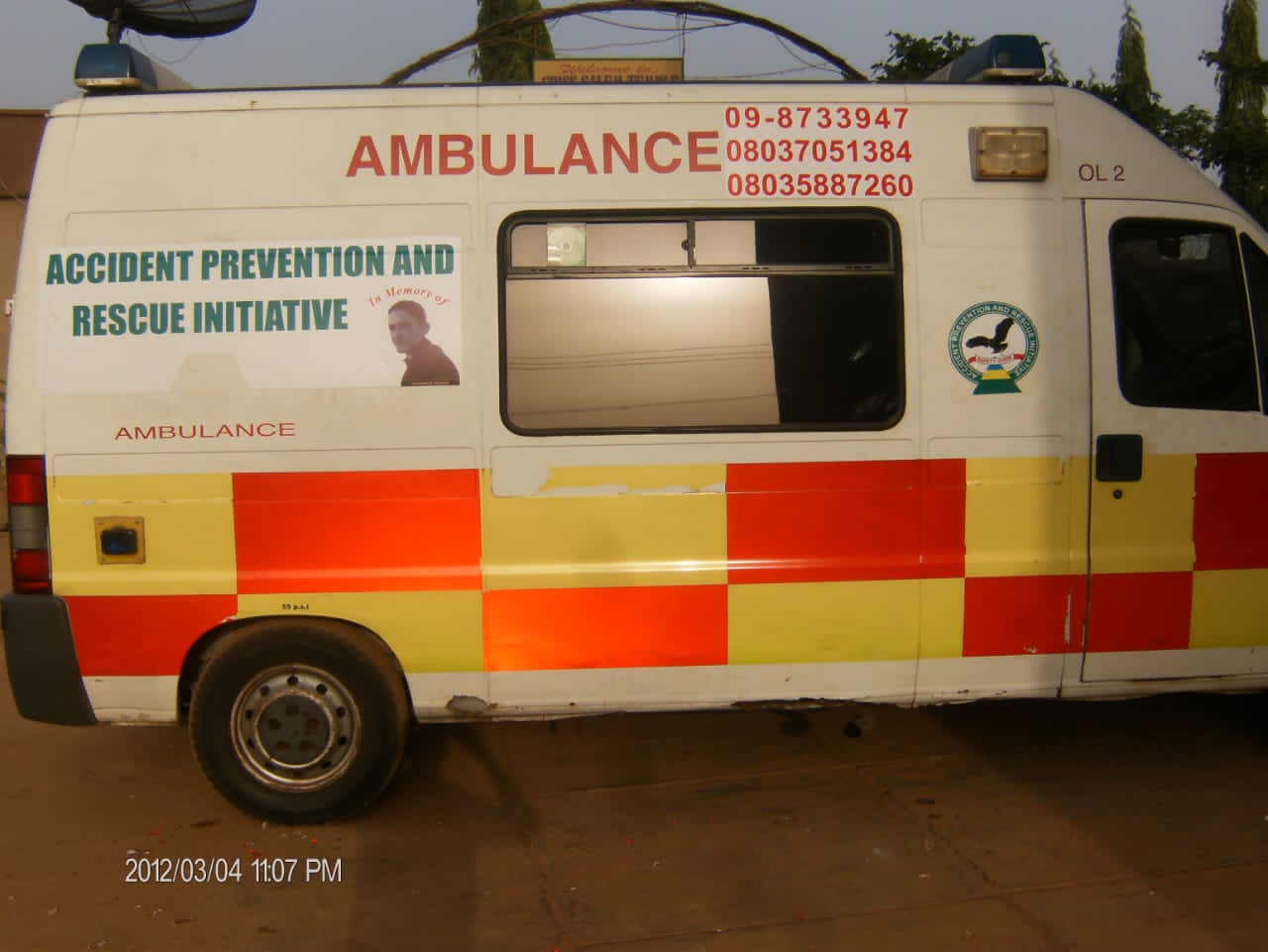
In conclusion, APRI did deploy and operated Ambulance rescue services in support of the FRSC ambulance pool at Kugbo axis along Abuja Keffi Expressway towards complimenting rescue for road crash victims within the axis. This was in 2011 to 2013.
In 2011, APRI organized and led multiple protests along Abuja Keffi expressway after a gruesome road crash that killed over 20 people. The protest resulted in the Ministerial restriction of tankers and articulated vehicles plying the road during traffic hours on that route.
What’s your advice to Nigerians?
My advice to Nigerians is to always be road safety conscious. Lives of road users should matter in Nigeria.
What are the demands of APRI from its local and international partners as well as well-meaning Nigerians?
We are appealing to National and International organizations including individuals passionate in saving lives to please donate ambulances to our organization towards joining hands with the FRSC towards saving lives of victims of road crashes.
Nigeria youths should volunteer to join road safety groups to save lives while companies and well to do Nigerians should donate ambulances towards saving lives.