










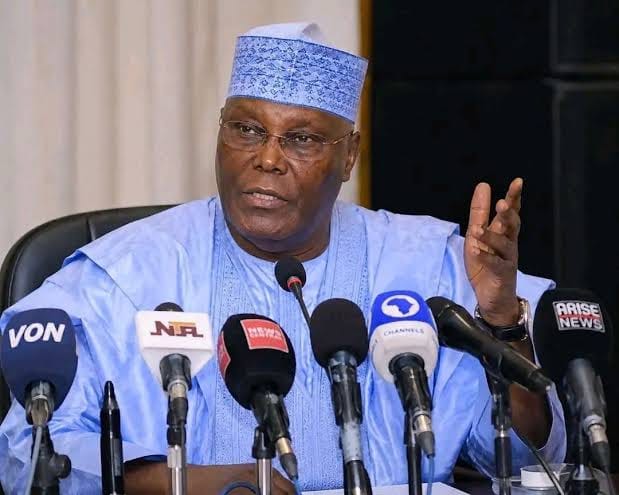
As Nigeria approaches the 2027 presidential election, the long-running controversy over the financial autonomy of the 774 Local Government Areas has once again assumed political prominence. Former Vice President and 2027 presidential candidate of the African Democratic Congress (ADC), Atiku Abubakar, has promised that, from his first day in office on May 29, 2027, federal allocations meant for local councils will be paid directly to them, regardless of the influence of state governors. While the proposal speaks directly to a constitutional and governance problem that has frustrated grassroots development for years, it also raises important questions about implementation, accountability, elected local councils and the political realities that could confront any president seeking to alter the existing arrangement, analyzes Ekuson Nw’Ogbunka, Our Managing Editor.
Atiku made the pledge in a statement issued through his official X handle by his campaign spokesperson, Kenneth Okonkwo. He said an ADC administration would uphold the rule of law and guarantee the constitutional independence of all three tiers of government, including the local government system.
The former Vice President based his position largely on the Supreme Court’s July 2024 judgment on local government financial autonomy. He accused the administration of President Bola Ahmed Tinubu of failing to fully enforce the judgment, arguing that continued dependence of local councils on state governments undermines democracy and violates the constitutional principle of autonomy.
Atiku further alleged that the Federal Government had avoided a confrontation with state governors by allowing them to retain substantial control over local government finances. He also linked the situation to the politics of the 2027 election, alleging that governors’ control over council resources could serve as an incentive for political support for President Tinubu’s re-election. These are serious political allegations, however, and they require evidence beyond assertion before they can be treated as established facts.
The former Vice President said his administration would respect court judgments, protect local government autonomy and ensure that public funds reach the people for whom they are intended. According to him, direct funding would bring development closer to Nigerians, reduce poverty at the grassroots and strengthen the capacity of local councils to respond to insecurity and other challenges.
Atiku’s argument has considerable appeal because local governments are constitutionally positioned as the tier of government closest to the people. Yet direct allocation alone may not automatically translate into development. The critical question is whether councils will possess the institutional capacity, competent leadership, transparent procurement systems and effective accountability mechanisms required to convert increased financial control into roads, healthcare, education, water, sanitation and security-related interventions.
There is also the question of the political structure of local government administration. Financial autonomy will have limited impact if elected local government councils are replaced or weakened by arrangements that compromise their democratic legitimacy. Any serious attempt to implement the Supreme Court’s position must therefore address not only the flow of money but also the independence, credibility and accountability of the institutions receiving it.
The movement tagged “Atiku Is For The People” has recalled that, by July 2026, two years after the Supreme Court ruling, implementation of local government financial autonomy remained a contentious issue. It claimed that N10.48 trillion had been allocated to the third tier of government during the period, while the question of how such funds should be accessed and administered remained unresolved. The figure and its interpretation, however, should be independently verified when used as the basis for assessing the scale of the alleged implementation gap.
Atiku’s promise therefore deserves to be judged on more than its political attractiveness. Direct payment of local government funds could represent a significant step toward genuine federalism and grassroots development if accompanied by transparent elections, strong auditing, public disclosure of council finances and enforceable sanctions for misuse. Without those safeguards, however, financial autonomy could simply shift the location of political control without necessarily improving governance.
Ultimately, Atiku’s May 29, 2027 pledge presents Nigerians with both a constitutional proposition and a political test. His commitment to direct funding of the 774 local governments addresses a widely debated weakness in Nigeria’s federal system, but voters will reasonably want to know precisely how his administration would implement the policy, enforce accountability and prevent local resources from being captured by another layer of political interests. The promise may be compelling, but its real value will ultimately be measured not by the declaration made during the campaign, but by whether it produces measurable development and greater accountability at the grassroots.