





By Ekuson Nw’Ogbunka
Abuja
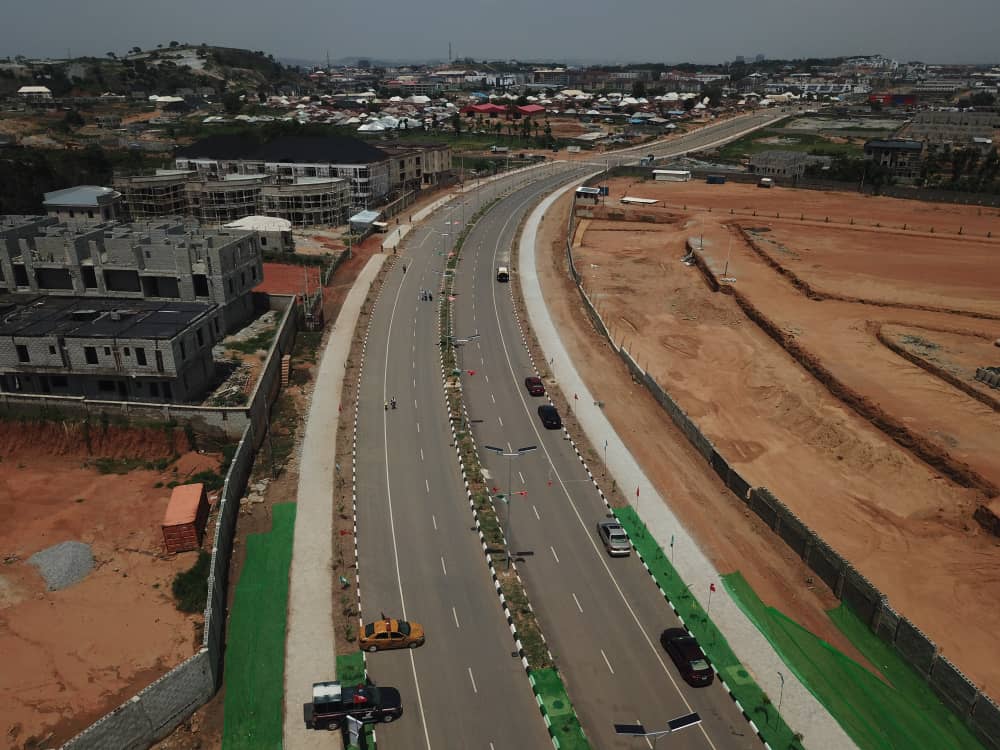
President Bola Ahmed Tinubu’s commissioning of the 3.9-kilometer Collector Road CN2, now Emmanuel Ogala Boulevard, and Important Local Street 5 in Katampe District does more than open a new route in Abuja. Delivered by CGC Nigeria Limited in a record seven months, the dual carriageway linking Katampe and Mabushi to Yemi Osinbajo Way and Wole Soyinka Way is being framed by the Presidency as proof of capacity under the Renewed Hope Agenda. A news analysis of the project, the politics around it, and what it signals for FCT governance.
The road itself is strategic infrastructure. CN2 is a dual carriageway with 2 traffic lanes, 1 parking lane, and a 2-meter median per side — 6 lanes total — plus underground stormwater drains, water pipes, sewer network, telecom ducts, solar streetlights, walkways and green verges. That scope turns an abandoned collector road into a complete urban corridor.
Speed is the headline. Awarded in November 2025, completed in seven months. For Abuja, where projects often stall for years, the timeline matters politically. It allows the Tinubu administration to counter criticism about slow delivery with a visible, usable asset before 2027 politics fully sets in.
Speaking through Vice President Kashim Shettima, Tinubu described CN2 as “more than an engineering achievement,” calling it a restoration of hope in government promises. The language is deliberate: infrastructure as political trust-building.
The security angle is central to the President’s message. “We have installed solar street lights, and today Katampe is bright at night. Abuja’s city life is coming back, and criminal hideouts are disappearing,” Tinubu stated. The administration is linking road lighting directly to safety and economic revival of nightlife.
That connection between light, mobility and dignity reflects a broader urban governance theory: well-lit, connected roads reduce crime and increase commercial activity. Whether CN2 sustains that impact will depend on maintenance and policing.
Tinubu used the event to publicly back FCT Minister Barrister Nyesom Wike, crediting him for “working round the clock to deliver results, rather than giving excuses.” The President listed boulevards, water projects and judicial housing as part of Wike’s portfolio.
“When I gave him the assignment to make Abuja a true capital city, I knew his track record. Barrister Wike, you have not disappointed,” Tinubu said. The endorsement strengthens Wike’s political capital and signals that FCT infrastructure is a key performance metric for the administration.
Wike, for his part, emphasized economic spillover. He noted the road had already triggered private estate and commercial construction and created jobs for labourers and engineers. In infrastructure economics, that “crowding-in” effect is the real multiplier.
The Minister also praised synergy with Minister of State Dr. Mariya Mahmoud, the FCDA engineering team, and National Assembly oversight chairs who, he said, acted as “development partners rather than bureaucratic obstacles.” That comment hints at smoother legislative-executive coordination on FCT projects.
FCDA Executive Secretary Engr Richard Yunana Dauda gave the technical overview: contract awarded November 2025, full scope includes drainage, utilities, solar lighting, and employment of Nigerians directly and indirectly. The road now connects Katampe to Mabushi, Jahi, Maitama and adjoining districts, cutting travel time.
For residents, reduced travel time and improved security are immediate gains. For the FCTA, opening Katampe accelerates land value and development, which feeds back into Internally Generated Revenue through ground rent and taxes — the same levies Tinubu urged residents to pay.
The warning against converting walkways to markets or vandalizing solar installations was not incidental. Abuja has a history of infrastructure degradation post-commissioning. Tinubu’s directive places responsibility on residents, shifting part of the governance burden from state to citizen.
CGC Nigeria’s Managing Director Mr. Lv Haiming noted the firm prioritized hiring and training local workers. Local content in construction contracts is both economic policy and political optics. It counters criticism of foreign contractors while building technical capacity.
Wike’s announcement that the team moves to Karu on Monday for a “massive water supply project” for satellite towns frames CN2 as part of a pipeline, not an isolated event. The 31-day commissioning schedule announced by the FCTA is designed to create momentum and media coverage.
Analysis: CN2 is a data point, not the full verdict, on Renewed Hope infrastructure delivery. It shows what concentrated political will, contractor discipline, and legislative cooperation can achieve in seven months. The real test will be replication across Abuja’s satellite towns, maintenance of CN2 itself, and whether the “hope” Tinubu claims translates into improved living standards beyond Katampe.