










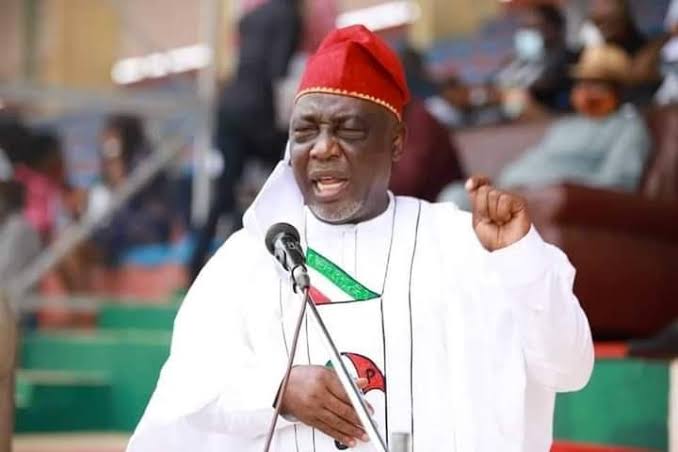
Senator Abba Moro is the Minority Leader in Nigeria’s 10th Senate and representative of the Benue South Senatorial District. He spoke with the Senate Press Corps recently, after presenting a motion on persistent killings in Apa, Igah, Ankpali and other parts of Benue South, and faulted in its entirety, the Federal Government’s (FG’s) approach to terrorism, and questioned the lack of prevention, prosecutions, and insists that ransom payments and dialogue only embolden bandits. our anchorman, Ekuson Nw’Ogbunka was there. Excerpts:
Could briefly speak on this your latest motion on insecurity?
The issue of killings in Nigeria has become almost a daily occurrence. It has turned into a routine — observing one-minute silences, discussing military funding, and moving on. My people in Apa, Igah, Ankpali and other parts of Benue South are dying, and we cannot continue like this.
Do you think the Federal Government is truly willing to tackle insecurity?
Whether the government believes it wants to fight insecurity is something only they can answer. What concerns Nigerians, however, is the persistence of these killings. Why does insecurity continue unabated?
Why do you think insecurity has lasted this long despite known threats?
Is it that, as a country, we are incapable of addressing it, even when the nature of these threats is well known? Whether it is Boko Haram in one region, banditry and abductions in Zamfara and the North-West, or kidnapping and armed robbery in the North-Central, these are familiar challenges. So why, after years and even decades, has the government been unable to put an end to them? What are we doing, and what are we failing to do?
How would you assess the Senate’s response to these killings so far?
Senate debates on insecurity often revolve around observing one-minute silences and approving funds, while security agencies mostly arrive after attacks have taken place.
You’ve visited operational areas. What did you observe?
In operational areas I have visited, security agencies are often seen recovering bodies after attacks. This raises a troubling question: why are they not preventing these killings? Why do they respond only after lives have been lost?
What role should intelligence play in Nigeria’s security architecture?
Globally, intelligence gathering is key. It involves collecting information to prevent attacks and apprehend those responsible. Why should Nigeria be an exception? Yet we’ve seen so few arrests and prosecutions of perpetrators.
Can you give a specific example from your constituency?
The recurring attacks in my constituency are deeply troubling. Take Ankpali Ediku in my local government area. The community was attacked on January 6, 2025, leaving about 11 people dead. Now, on April 12, 2026 — almost a year later — another attack has occurred, claiming 14 lives.
Were security personnel deployed after the first attack?
Yes. Security personnel were deployed after the first attack, including the Mobile Police and Operation Whirl Stroke, but the community still suffered another deadly invasion. During my visit, I even offered to support the police by reconfiguring their vehicle to suit operational needs. They mentioned a cost, but when I insisted on assessing the vehicle first rather than providing funds outright, I never heard from them again. Now, the same community has been attacked once more, and once again, we are observing a minute of silence. It is very disheartening.
Attacks on military personnel and senior officers are rising. Why?
It is not surprising. When a government appears to be yielding or negotiating with terrorists and bandits, it emboldens them. Why wouldn’t they extend their attacks to military targets? I’m also concerned by reports that some bandits possess more sophisticated weapons than security agencies. That is unacceptable.
What should be done about terrorist hideouts?
These elements must be decisively confronted. Their locations are known — they operate from forests that security agencies are aware of. In some cases, they even emerge openly to negotiate with the government. This should not happen.
As a former Minister of Interior, what is your position on negotiating with terrorists?
During my time as Minister of Interior, I served for nearly four years, and I can say this clearly: you do not negotiate with terrorists. You do not pay ransoms. You identify them and neutralise them. That is the global standard.
How do other countries handle citizens caught in conflict zones?
When an American citizen was caught in a conflict zone, the government launched a rescue operation and recovered that individual within 24 hours. They deployed all available resources for just one citizen. Why can’t we do the same?
What’s your final word on governance and the rehabilitation of ‘repentant’ terrorists?
Across the country, governance seems to have taken a backseat to politics. Leaders are focused on securing second terms rather than effectively delivering on their first. Meanwhile, ordinary Nigerians continue to suffer. And if people have carried out killings and destruction, and are then released by the same authorities responsible for prosecuting them, what message does that send? That is the fundamental question.