










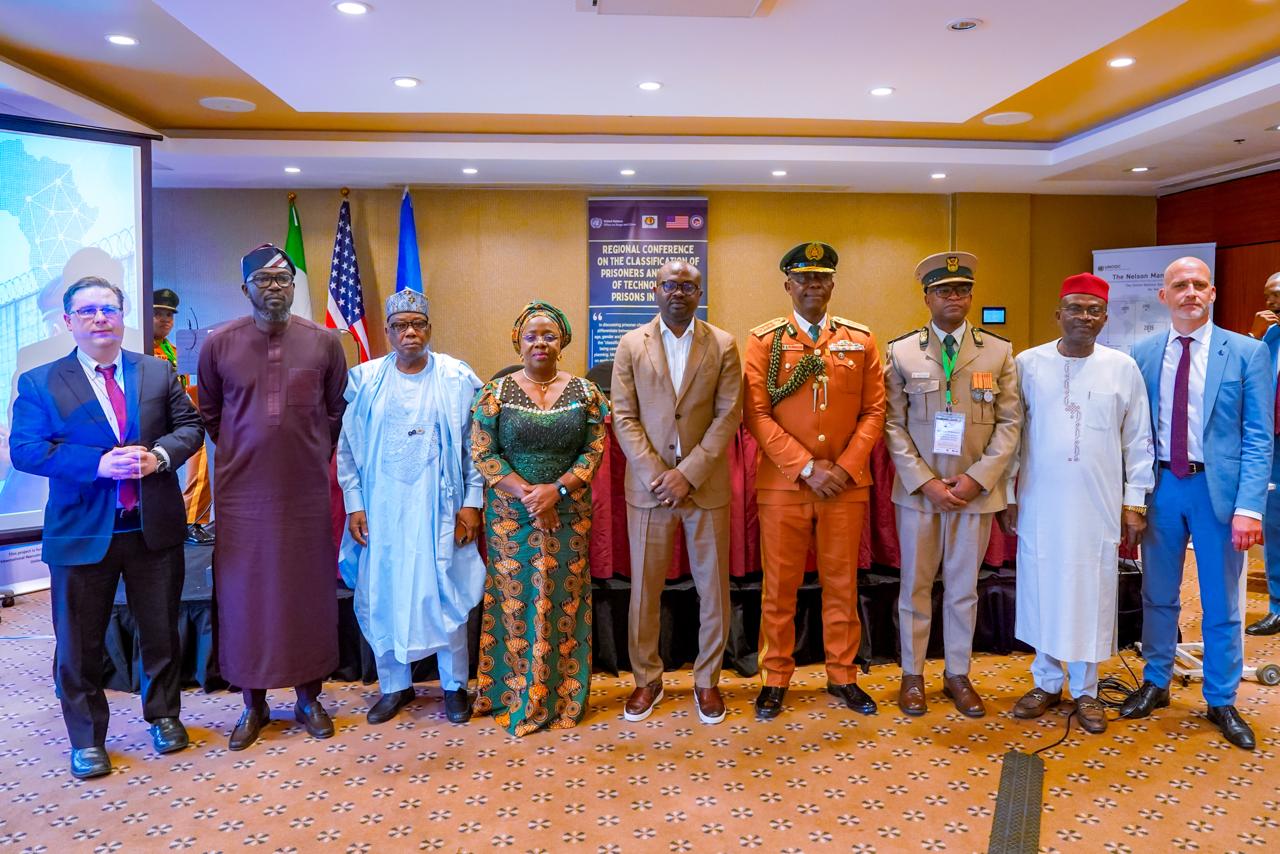
In this piece, Ekuson Nw’Ogbunka Our Managing Editor in Abuja the Federal Capital Territory (FCT) writes that at a UNODC conference in Abuja, the Minister of Interior said Africa’s prisons must leave the 19th century behind. His pitch: use technology, data, and rehabilitation to turn correctional centres into places of transformation, not just punishment.
The image of African prisons as overcrowded, underfunded warehouses is one the Federal Government now wants to erase. On Tuesday, the Minister of Interior, Hon. Dr. Olubunmi Tunji-Ojo, told a regional gathering that the future of corrections is digital, data-driven and humane.
Speaking at the UNODC Regional Conference on Prisoner Classification and the Use of Technology in Prison Settings in Africa, he said the old model no longer works. “The approach to correctional service management in the 19th century cannot be the same as the 21st century,” he stated.
The conference, organised with ACSA, INL and other partners, brought together correctional leaders to agree on common standards. For Nigeria, it was an opportunity to showcase reforms already underway at home.
The Minister’s first point was diagnosis. “We spend too much time prescribing solutions to problems we do not fully understand,” he said. He challenged leaders to ask three questions: What is the problem? What is the solution? What is the timeline?
His answer to the first question is clear: insecurity and inefficiency in correctional facilities. His answer to the second: technology. “Technology is no longer optional—it is essential to building secure, efficient and humane correctional systems,” he declared.
Nigeria, he said, is already seeing results. Since this administration came in, there has been “no successful prison attacks or jailbreaks.” He credited this to digital transformation, better data management and improved inter-agency collaboration.
The specifics matter. Inmate records are now digitized, including biometrics and photographs. That database, he explained, helps security agencies respond faster to threats and track offenders across the country.
But Tunji-Ojo was careful not to overstate technology. “Technology alone is not enough. It will never replace human beings. Technology is only a catalyst that improves efficiency. Investment in technology must go hand in hand with investment in human capacity.”
His second big push was integration. He urged African states to stop treating correctional services as isolated institutions. Instead, they should be part of national security architecture, with real-time information sharing across agencies and across borders.
“I look forward to an Africa where a criminal fleeing one country cannot simply find refuge in another because our systems are connected and our institutions collaborate,” he said. For a continent with porous borders, that vision is ambitious.
The third shift is philosophical. The Minister wants prisons to be about more than confinement. “A correctional centre should be a place of transformation, rehabilitation, restoration, and hope—not simply a place of confinement.”
That means education. In Nigeria, thousands of inmates are now in formal schools, some even in postgraduate programmes. Others are in vocational training and skills development.
It also means protecting the young. Tunji-Ojo called for stronger laws on borstal institutions and juvenile justice. “Our young people deserve an opportunity for rehabilitation, not a pathway into deeper criminality,” he said. Young offenders, he insisted, must never be mixed with hardened criminals.
The government says the approach is working. Structured rehabilitation and education have led to “a dramatic reduction in recidivism,” turning some facilities into centres of productivity.
The message to partners was one of appreciation. He commended UNODC, ACSA and INL for creating a platform to harmonize standards. Regional cooperation, he argued, is the only way to deny criminals safe havens.
The Minister’s tone was both practical and idealistic. He acknowledged the problems but framed them as solvable by Africans. “There is nothing wrong in Africa that cannot be put right by Africans,” he said.
Declaring the conference open, he made his final call: embrace technology as an indispensable tool. Not for surveillance alone, but for administration, classification, rehabilitation and reintegration.
Conclusion: The pitch from Abuja is simple. Secure the walls with data, fill the cells with skills, and treat inmates as people who can return to society. If Nigeria can sustain the no-jailbreak record and scale the education programmes, it may have a model other African countries can copy. The conference ended, but the real work of implementation begins now.