










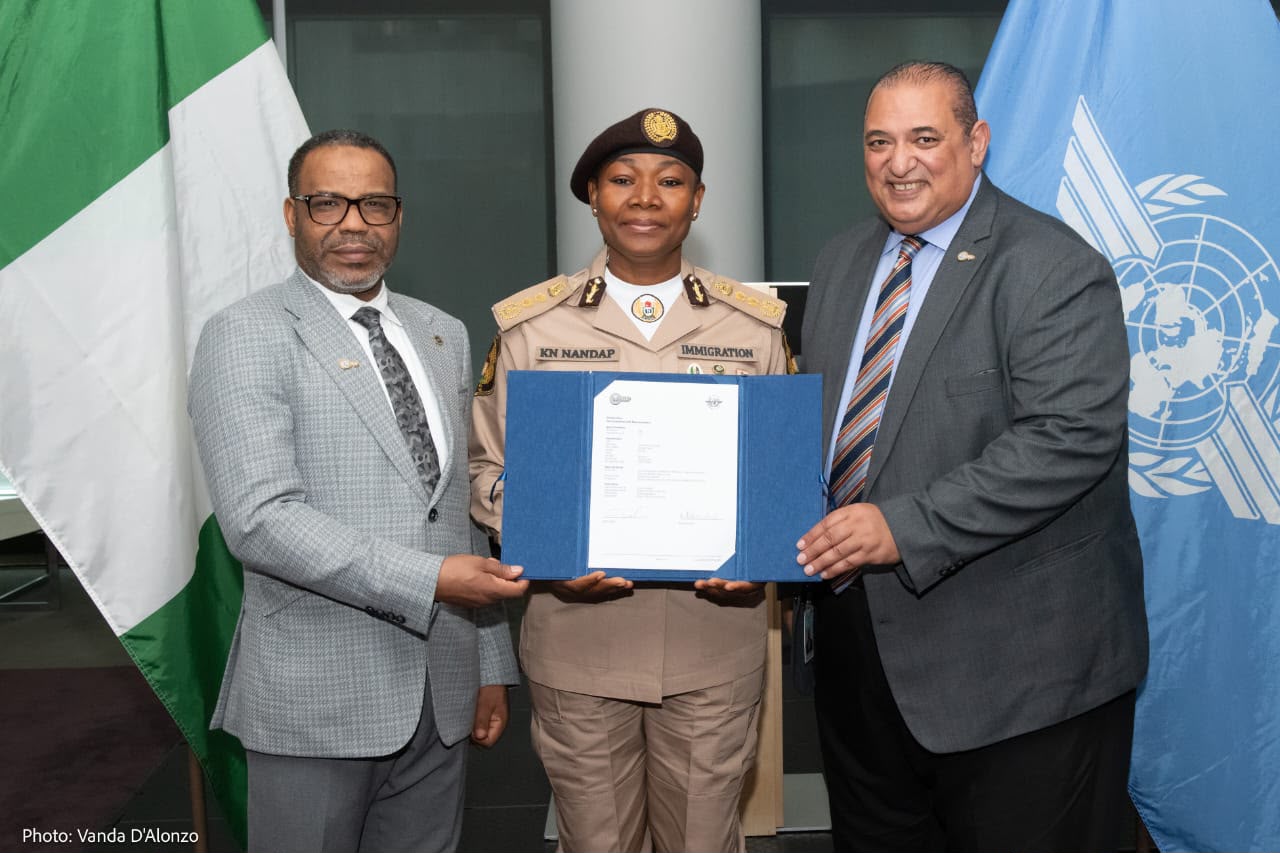
For years, some Nigerians faced extra checks at foreign borders because of passport authentication gaps. On July 13, 2026 in Montreal, that changed. Nigeria completed a critical security upload that puts the green passport on the same digital footing as others worldwide, reports Ekuson Nw’Ogbunka Our Managing Editor in Abuja the Federal Capital Territory (FCT..
It happened quietly, but the impact will be felt at airports from London to Dubai. The Federal Government has completed the upload of all Nigeria’s Country Signing Certificate Authorities, CSCA, into the International Civil Aviation Organization, ICAO, Public Key Directory, PKD.
The ceremony took place on Monday, 13th July 2026, at ICAO Headquarters in Montreal, Canada. The update was confirmed in a press release e-signed on 15th July, 2026 by DCI Akinsola Akinlabi, Service Public Relations Officer of the Nigeria Immigration Service.
Leading the Nigerian team was the Comptroller-General of Immigration, KN Nandap, pcc, fsmn. For her and her officers, the mission was simple: fix a technical problem that had caused embarrassment and delays for Nigerians traveling abroad.
The problem was “passive authentication.” At some foreign border control points, systems could not automatically verify the digital signature on Nigerian passports. That forced manual checks, longer queues, and questions many travelers found humiliating.
With the full import of all existing CSCAs into the ICAO PKD, that gap is now closed. Nigeria has established a complete “chain of trust.” In plain terms, every Nigerian e-passport can now be verified instantly by border systems in all ICAO PKD member states.
The process was driven by the Ministry of Interior under Honourable (Dr) Olubunmi Tunji-Ojo. Officials said it aligns with President Bola Ahmed Tinubu’s Renewed Hope Agenda, which prioritizes secure digital identity and better international cooperation.
For the Nigeria Immigration Service, this is more than a technical fix. It is an investment in credibility. A passport is not just a travel document. It is a statement of how a country manages identity, security, and trust.
NIS officials said the upgrade reflects continued work on secure digital identity management. Over the last few years, the Service has moved to biometric passports, centralised data, and now full ICAO PKD integration.
What changes for the average Nigerian? Less scrutiny. Faster clearance. At airports where Nigerian passports previously triggered secondary checks, border systems can now authenticate them in real time, just like passports from the US, UK, or Canada.
The benefit goes both ways. For Nigeria, it reduces fraud and counterfeiting risks. For other countries, it increases confidence that a Nigerian passport is genuine and its holder has been properly vetted.
The upload also signals Nigeria’s commitment to global interoperability. In a world where borders are managed by data, being outside the ICAO PKD meant being outside the standard. That is no longer the case.
Conclusion: The green passport has not changed in colour, but its digital backbone has. With the ICAO security link now complete, Nigeria has removed one major barrier to seamless travel. The test will be at the border, where millions of Nigerians hope the only question is “Welcome home.”