









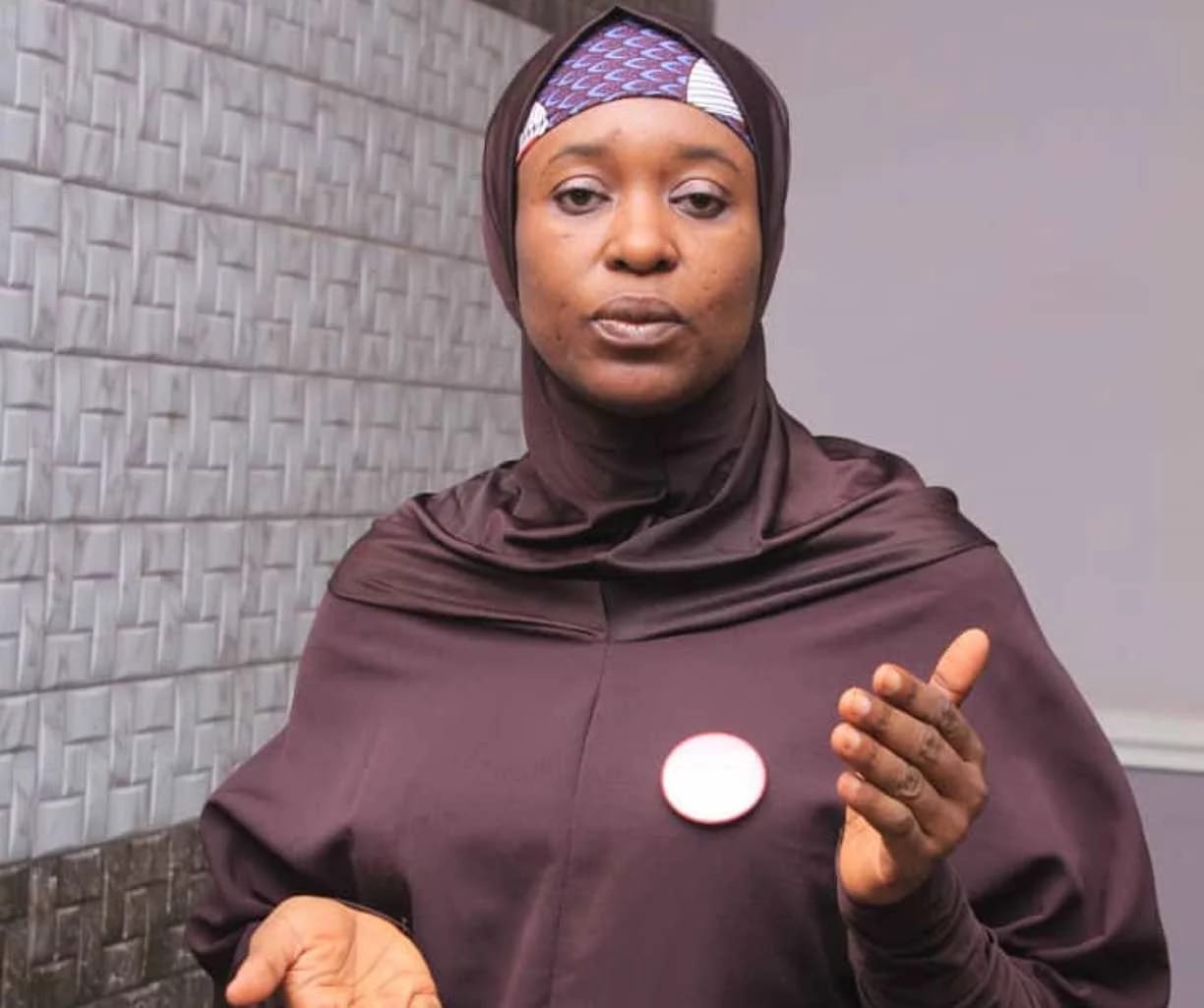
Weeks after the Nigeria Democratic Congress (NDC), concluded its Federal Capital Territory (FCT) senatorial primaries, frontline aspirant Aisha Yesufu has broken her silence. In a strongly-worded statement titled “On the Record: NDC Primaries… A Better Abuja Is Inevitable,” the activist-turned-politician dismissed rumors of a pre-election withdrawal. She insists she stayed in the race to the end, even as she alleges the process was rigged against grassroots voices. The fallout now spotlights deeper tensions within Nigeria’s emerging third-force movement and the battle over how parties choose their candidates, writes Ekuson Nw’Ogbunka in Abuja.
Aisha Yesufu pushed back hard against speculation that she dropped out before voting ended. She said she remained in the contest to honor the mandate of her supporters and the people of Abuja.
“As the dust settles on the NDC Primaries, I want to set the record straight: I did not quit, I did not drop out of the race. I stayed to the end,” she stated. “I share my truth because the people of Abuja deserve the truth.”
She traced her entry into electoral politics to a core belief: structural change cannot come from commentary alone. For her, transformation requires occupying rooms where laws are made.
“I came into politics from a deep conviction: that to drive the transformation we hope to see, it is not enough to complain from the outside. You must step into the ring with your convictions and fight to get into positions where decisions are made with the weight of the law,” she noted.
Aisha said she understood the systemic barriers facing values-driven candidates but refused to dilute her principles. “I did not leave advocacy to go into politics. I took advocacy into politics,” she affirmed.
Her campaign ran under the: “AishaforSenate2031 banner,” signaling a long-term, multi-cycle strategy rather than a single-election gamble.
Reflecting on the primaries, she described the exercise as a “predetermined outcome dressed in procedural formalities.” Yesufu alleged the process was engineered from the start.
According to her, party leaders repeatedly violated internal guidelines, postponed dates without explanation, and changed venues at the last minute to shut out ordinary members.
The most damaging allegation, she said, was: “The switch from direct primaries to a centralized delegate system. That shift moved decision-making from ward levels to one hall.”
“A delegate-based process was introduced to be conducted at a central location instead of the direct primaries to be conducted at Local Government headquarters,” she revealed.
“When the moment came, the contest was not decided by delegates in the open; it was affirmed in a closed room, away from the people whose voices it was supposed to reflect,” she added.
While the NDC has publicly described the FCT primaries as free and fair, Aisha dismissed that narrative. She argued the facts on ground contradict justice, fairness, and the Electoral Act.
Despite the alleged irregularities, the activist cum politician announced she will not pursue legal action or the party’s internal grievance channels. She called them “designed to wear people down.”
Instead, she framed the experience as a masterclass in party politics. “I now understand the architecture of the system in ways no textbook, no punditry, amount of outside observation could ever teach.”
“I leave this process with something far more valuable than a ticket; I leave with clarity,” she said, suggesting the lessons will shape future strategy.
She was careful to limit her criticism to the FCT race, refusing to generalize about NDC primaries in other states.
Ahead of the general elections, Aisha reaffirmed loyalty to the NDC. She said that despite structural flaws, the party remains critical for national rescue and provided space for the electorate’s preferred presidential option.
She warned establishment politicians that her grassroots machinery remains intact. The volunteer network, SAY-Nation, she argued, cannot be dismantled by backroom deals.
“This is not the end. What we built, the network, the credibility, the grassroots trust, cannot be taken away in a backroom. A better Abuja is inevitable,” she concluded.
The episode underscores three dynamics shaping Nigerian politics: the rapid rise of the NDC as a third-force platform under national scrutiny; the recurring conflict between direct and indirect primaries, with centralized delegate systems prone to elite capture; and the emergence of advocacy-driven candidates like Aisha who are building durable, citizen-led movements instead of one-off campaigns.