










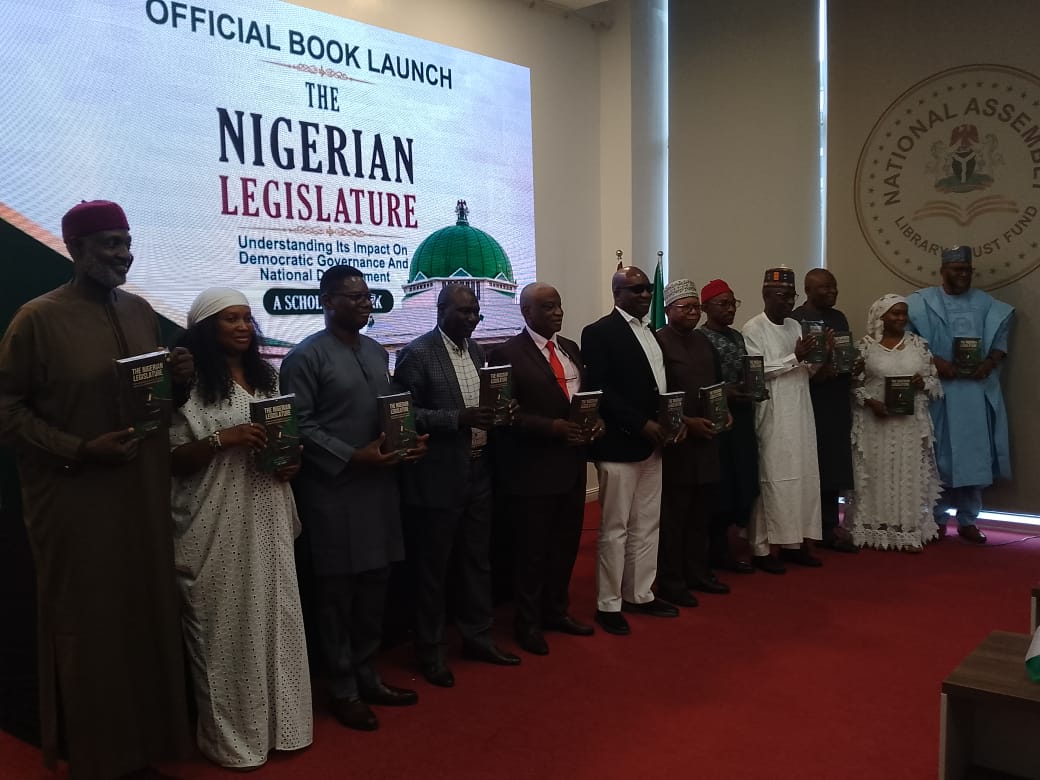
The National Assembly (NASS) Library Conference Hall in Abuja was filled on Monday with lawmakers, scholars, journalists, and public servants who gathered for the presentation of a new book that seeks to demystify one of Nigeria’s most misunderstood institutions. The Nigeria Legislature: Understanding Its Impact on Democratic Governance and National Development authored by Ezerel Tabiowo, Media Adviser to the Ninth Senate President Ahmad Lawan, was launched to wide acclaim, with speakers describing it as a timely contribution to legislative scholarship and public accountability, observed Ekuson Nw’Ogbunka, Our Managing Editor in Abuja.
Opening his introductory remarks, Tabiowo said he stood “with a heart overflowing with gratitude” as a moment he had long anticipated finally arrived. He noted that every author knows the feeling of moving from the solitude of research to the warmth of public presentation.
He thanked the gathering of distinguished persons for honouring the work with their presence, describing their support as validation of the importance of legislative scholarship to the health of Nigeria’s democracy.
Tabiowo reserved his deepest appreciation for his principal, former Senate President Ahmad Ibrahim Lawan. “He has been far more than an employer. He has been a mentor, a teacher, and a model of dignified public service,” he said.
Recalling his years as Chief Press Secretary during the Ninth Senate, Tabiowo said the experience was “an education that no university could have provided.” He watched Senator Lawan navigate executive-legislative relations, uphold legislative professionalism, and make difficult decisions with calm deliberation.
“It was this privileged vantage point, this ringside seat at the workings of the Senate, that planted the seed from which this book eventually grew,” he stated, adding that he owes Senator Lawan a debt that words alone cannot repay.
The author also expressed gratitude to the Chairman of the occasion and all Special Guests of Honour, saying their presence was both an honour and an endorsement of the need to study the legislature more seriously.
To the Book Reviewer, Senator Ita Solomon Enang, Tabiowo extended sincere appreciation. He noted that Enang’s legislative experience, his role as an executive-legislative liaison, and current diplomatic posting to Germany give him “a perspective on the legislature that is uniquely broad and deep.”
He acknowledged Foreword Contributors Senator Victor Ndoma-Egba, SAN, and former Attorney General Mohammed Bello Adoke, SAN. “Your reflections and legal erudition have immeasurably enriched this work,” Tabiowo said.
The author thanked the Clerk to the National Assembly, Barr. Kamoru Ogunlana; the Secretary, Directorate of Research and Information, Dr. Ali Barde Umoru; and the entire NASS management and staff for years of cooperation that aided both his professional duties and this scholarly project.
He also appreciated the management of the National Assembly Library Trust Fund led by Executive Secretary, Rt. Hon. Henry Nwawuba, for approving the use of the facility for the launch.
Tabiowo paid tribute to colleagues in the Senate Press Corps and the West African Parliamentary Press Corps, saying their shared commitment to legislative coverage between 2010 and 2019 was a constant source of encouragement.
On a personal note, he dedicated the book to his family: his wife Nkeiruka, his mother, his siblings, and the memory of his late father, Mr. Paul Tabiowo. “You have sustained me with love, with patience, and with belief. This book is as much yours as it is mine,” he said.
Addressing the central question of why he wrote the book, Tabiowo said: “The legislature is the most misunderstood institution in our democracy, and misunderstanding breeds distrust, and distrust weakens the very foundations of democratic governance.”
He argued that while the NASS often makes headlines over remuneration debates, leadership crises, and confrontations with the executive, that is not the whole story. The real story, he said, includes committee work on budgets, oversight hearings, constituency representation, and landmark laws that have transformed the nation’s legal framework.
Tabiowo listed examples such as constitutional amendments on financial autonomy for state legislatures and the opening of political space for younger Nigerians. “This book attempts to tell that whole story,” he said.
He clarified that the book is not an exercise in institutional praise. “The legislature has its share of failings, and I have documented them with the same rigour with which I have documented its achievements. It is an exercise in understanding,” he explained.
On the research process, Tabiowo said it spanned several years and involved constitutional provisions, legislative records, committee reports, judicial decisions, and scholarly literature. He grounded his observations as a journalist and media aide in data and the analytical frameworks of legislative studies.
He admitted the journey was sometimes lonely, with long hours and multiple drafts. But the conviction that the Nigerian legislature deserved a comprehensive and balanced examination sustained him. The support of contributors to the foreword also gave him confidence to complete the work.
The author therefore, outlined his hopes for the book: that legislators and staff will find it a useful resource; that scholars will build further research on it; that civil society and the media will use it for more informed advocacy and reporting; and that citizens will see the legislature as an institution that belongs to them and demand the accountability they deserve.
Closing, he described the National Assembly as the forum where Nigeria’s diversity is represented and where collective will is translated into law. “It is the check upon executive power without which democracy cannot survive. It is an institution worth studying, worth understanding, and worth strengthening. This book is my contribution to that essential work,” he said.