









With 2027 approaching, the conversation in Anambra South is shifting from promises to proof. Across the seven local government areas, a familiar question is resurfacing at town halls, market squares, and political meetings: who can truly translate aspiration into delivery?
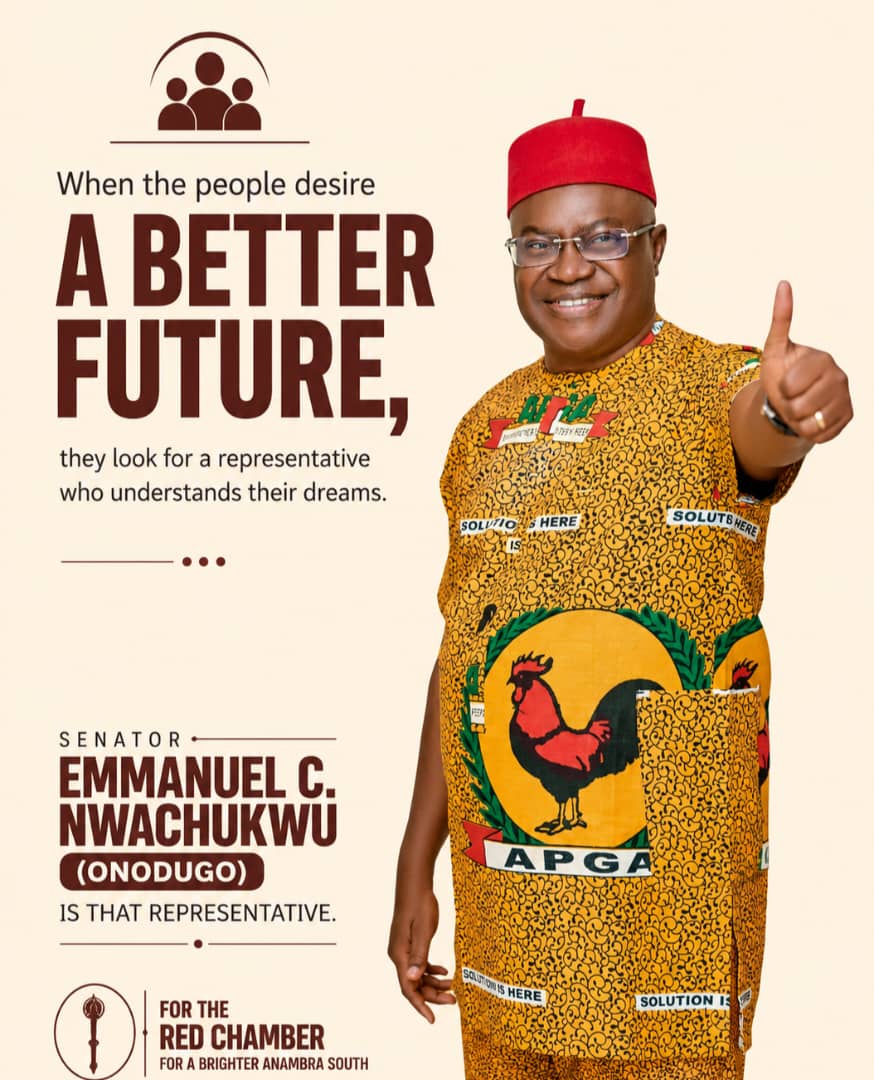
Amid that debate, the name Senator Emmanuel C. Nwachukwu, Onọdụgo, keeps coming up. His supporters frame him as the embodiment of competence, compassion, and continuity. His critics ask a harder question: in a zone long plagued by unfulfilled expectations, can any one personality be the “messiah” Anambra South has been waiting for?
To answer that, we must look beyond slogans and examine three things: the record, the context, and the expectations now being placed on one man, writes Ekuson Nw’Ogbunka Our Managing Editor in the Federal Capital Territory (FCT).
The opening argument from Nwachukwu’s camp is constitutional, not personal. “The path to progress, prosperity, sustainable development, and lasting stability is largely determined by the quality of the personality entrusted with the responsibility of serving the people.” That premise is hard to dispute.
His advocates argue that genuine service inspires trust, and trust is what makes development possible. In Anambra South, where past representation has often been judged by abandoned projects and poor constituency engagement, that point resonates.
The materials presented describe Nwachukwu as “a man of proven integrity, compassion, competence, and unwavering dedication to the service of humanity.” The emphasis is on track record, loyalty, selfless service, and leadership, as the basis for a return to the Red Chamber.
Proponents say this election is “another historic opportunity” for ndi Anambra South to choose a representative whose vision can translate aspirations into tangible results. The framing is urgent: choose now, or risk another cycle of drift.
The write-ups list specific areas of focus: youth empowerment, community development, economic growth, welfare of the people, support for entrepreneurs, farmers, artisans, students, women, and families. It is a broad agenda aimed at touching every demographic in the senatorial zone.
One of the strongest claims is that “continuity remains the surest path to sustained progress.” The logic: ongoing projects and relationships in Abuja are better protected by retaining an incumbent who already understands the levers of power.
Supporters point to “consistent engagement with communities and advocacy for the interests of Anambra South” as evidence that Nwachukwu understands both the challenges and opportunities of the district. For constituents tired of Abuja-based absentee representation, that matters.
He is repeatedly described as “a symbol of hope, service, and progress” and “a dependable voice.” In politics, symbols move votes. But symbols also carry risk, they raise expectations to almost messianic levels. Phrases like “maka oganiru Anambra South” and calls to “unite beside competence, experience, and purposeful representation” are designed to create a sense of collective mission. It is classic mobilization language ahead of an election cycle.
A critical analysis must ask for specifics. Which bills has he sponsored? Which projects have been completed, commissioned, and are being maintained? What federal allocations or interventions has he attracted to the seven LGAs? The current write-ups assert capacity but offer few verifiable data points.
Calling any politician the expected messiah is politically dangerous. It personalizes systemic problems. Roads, schools, health centres, and youth jobs in Anambra South will not be solved by one senator alone. They require federal budgetary support, state collaboration, local government action, and community ownership.
Anambra South is not a one-man race. Other aspirants will also campaign on competence and delivery. Voters will compare not just rhetoric, but access, influence in the Senate, and ability to work across party lines.
The promise of “expanded opportunities for our youths and women” will be measured by scholarships, skills programs, grants, and appointments, not by speeches. That is where incumbency can be audited. “Improved infrastructure” is mentioned, but which roads, which markets, which water projects? Constituents in Orumba North, Orumba South, Nnewi North, Nnewi South, Ekwusigo, Aguata, and Ihiala will each have their own priority list.
The materials highlight “loyalty” and “selfless service.” In Senate politics, loyalty to party and to constituency often collide. How Nwachukwu navigates that, especially on issues affecting Ndigbo and the South East, will define his second term narrative. If trust is the foundation of productivity, then the metric must be impact. Town hall reports, constituency project tracking, and feedback from traditional rulers and PGs will matter more in 2027 than endorsements.
By positioning him as the answer to progress, prosperity, and stability, the campaign sets a very high bar. If elected and results lag, disillusionment could be sharper than if expectations were managed. Beneath the endorsements, the voter question is practical: Will my road be fixed? Will my child get a job or a skill? Will our market have light and security? The “messiah” framing must ultimately be answered with deliverables.
The campaign’s strength is its focus on experience and continuity. Its challenge is to convert that into a transparent scorecard that ndi Anambra South can verify, community by community. Senator Emmanuel C. Nwachukwu (Onọdụgo) is being presented as the tested hand for Anambra South in 2027. Whether he is the “expected messiah” depends less on the title and more on evidence.
In a democracy, no single person saves a zone. But the right representative, with the right capacity and the right alliances, can make the difference between stagnation and progress. Anambra South now has to decide if Nwachukwu is that difference, not by faith alone, but by facts.